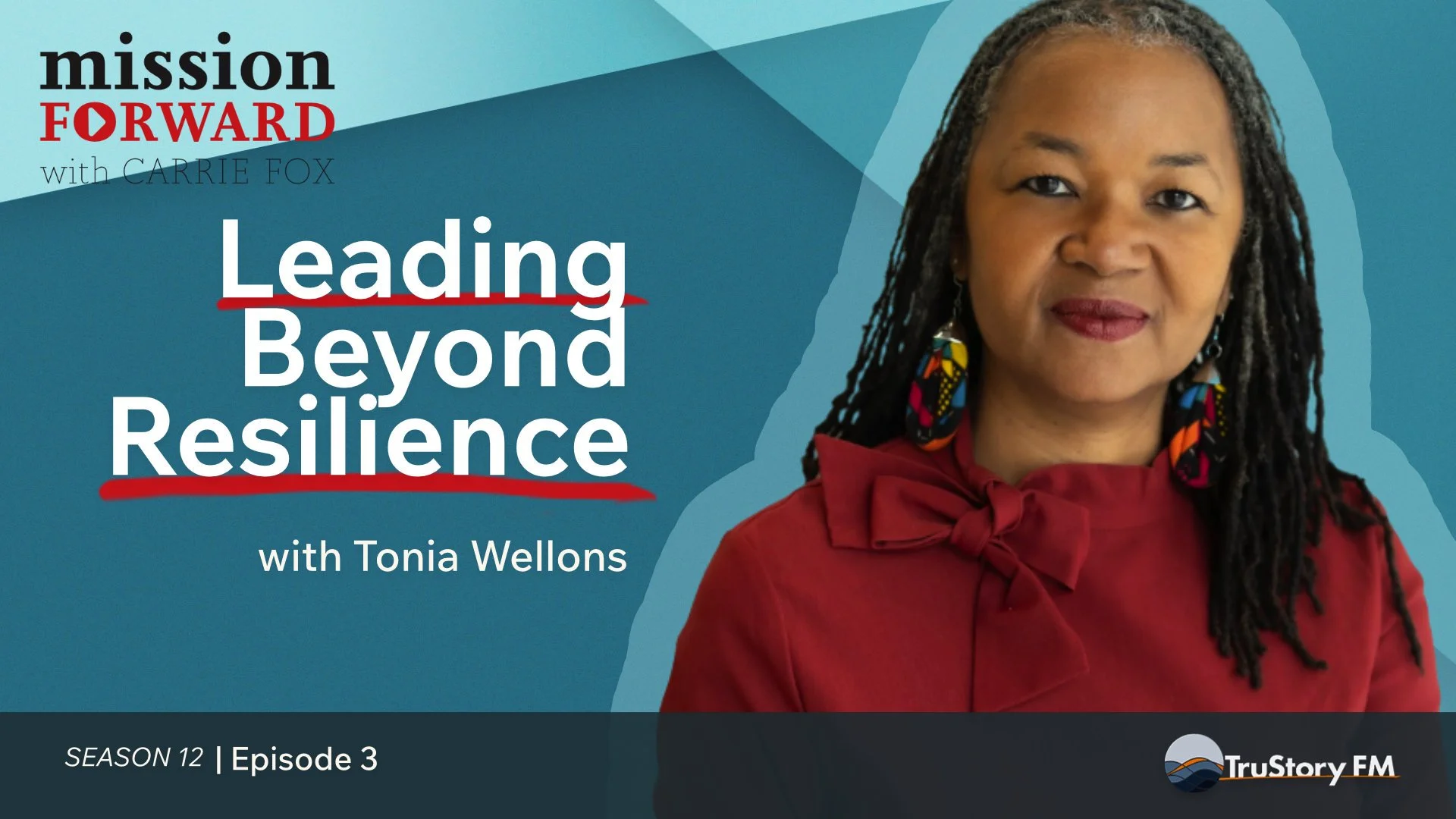
Leading Beyond Resilience with Tonia Wellons
About This Episode
In a recent staff survey at the Greater Washington Community Foundation, 100 percent of employees said they were clear on the organization's mission and vision.
Six years ago, that number was 39 percent.
That gap is what happens when an organization decides, at the height of a pandemic, to stop thinking in three-year cycles and commit to a ten-year framework instead. Tonia Wellons was thirty days into her role as president and CEO when COVID hit — canceling a 600-person gala, sending staff home, building a crisis response from scratch. And then, as the uncertainty stretched on, she and her board planned further out, not less. Because the plan isn't a prediction. It's a fixed point. And fixed points are most valuable when everything else is moving.
What's moving right now is almost everything. In 2020, the crisis had a shape — federal resources flowing outward, community energy concentrating around visible needs. Now the disruption comes from a different direction. What Wellons calls "dispersed energy" has replaced collective momentum: people still care, but without a center of gravity, that care is very hard to organize — and very hard to sustain.
Nonprofit leaders are resilient by training. But resilience and endurance are different capacities. Over ten consecutive years of crisis, the sector has been asked to sustain both, and the cumulative cost is real. Boards that aren't actively asking how to lighten that load are going to lose people — not in a single wave, but in quiet rolling exits. Some of those, Wellons is careful to note, are the right response. A thoughtful departure or sabbatical isn't failure. It's a sector populated by human beings.
The same honesty shapes how she talks about the foundation-nonprofit relationship. The power dynamic is real, she says. But the way through it is relational, not structural — funders explaining why they stopped doing something, nonprofits naming the blind spots that foundations can't see from where they sit. The alignment the sector keeps reaching for will arrive person to person, or not at all.
Last fiscal year, the Greater Washington Community Foundation granted approximately $70 million — a record — while donor giving and national philanthropic support both reached new highs. None of it happened because the environment got easier. It happened because the foundation had a fixed point, and a leader who understood that holding steady and standing still are not the same thing.
Links & Notes
-
Carrie Fox
Hello and welcome to Mission Forward. I'm Carrie Fox. For more than 25 years, I have worked alongside nonprofit and foundation leaders who do the essential work of holding communities together. And often they're doing that work in moments of deep uncertainty. And they, like you, are being the leaders we need. But what happens when the moment needs more than we have? That's why this season we are going behind the scenes of our brand new 2026 Insights on Purpose report. It's research that takes the pulse of hundreds of nonprofit and foundation executives all over the country and asks a simple but profound question. How ready do you feel for what's ahead? Well, what we found in that research was a striking duality. Leaders are under historic pressure, and yet still many feel very confident about the future. And that tension, that tension we hold between concern and confidence, and how to lead through it, well that is the space we are exploring all season long. Today, we are talking with one of the leaders who is living that duality and serving as a steady force for her community among so much uncertainty around her. Tonia Wellons is the president and CEO of the Greater Washington Community Foundation, the largest public foundation in the DC region with over $500 million in assets, $90 million in annual grants, and a 50-year track record of mobilizing community resources. All in all, the Greater Washington Community Foundation has invested more than $1.8 billion to build equitable, just, and thriving communities. And I have never seen them more grounded in their values than I have in recent years under Tonia's leadership. Tonia, I am so honored to have you here on Mission Forward. Thanks for being with us today.
Tonia Wellons
It's my pleasure, Carrie. Thank you for having me.
Carrie Fox
Tonia, you actually helped inspire some of the focus of this research as we had some conversations early, early on in that exploration process. And I wonder if you could take me back, as much as you want to, to the time leading through 2020. Right? What it felt like to be a leader then and how it feels to be a leader now. So what feels the same? What feels different?
Tonia Wellons
Sure. Thanks, Carrie. You know, hearkening back to uh to 2020, there's a wave of memories that come to mind. First, you'll remember that I was just appointed in March of 2020. Um and so uh I was a new CEO, uh having sat in the seat as an interim for just a few months prior, had just been named and was given the daunting uh responsibility of deciding whether to cancel a gala where we were expecting 600 people, um to send our staff home for what we thought was going to be about, you know, two or three weeks, and um for helping the organization to think through what our COVID response strategy was going to be. And that was all within the first 30 days of um of being on the job, of being named president and CEO. One of the true marks of um of a good leader is making few but really solid, good quality decisions. Um some that you get time to think long and hard about and some that you have to make um in a moment's notice. And so I was really put to the test um pretty early in my tenure. Um one of the things that I do recall that was the silver lining, I'd say, in those dark moments, was really the way that the community rallied around those who were at the sharpest intersection of challenges, you know, people who were uh directly impacted, restaurant workers, um essential employees, um vulnerable communities. I mean there was this real sense of we gotta protect our people. We gotta make sure that people have access to food and personal protective equipment and water and their kids have laptops. And um you know, in the midst of tragedy and um deep uncertainty, it is always amazing to watch people rally and um sort of fight for people and fight for what's right. Um it's a very big contrast, I think, to what we're experiencing right now, where there's just so much um dispersed energy. I think there are a lot of people who care. And um we don't necessarily have government alignment with community, and that's a really big difference and big nuance, uh in that there are not resources flowing from the federal government to local communities to respond to the challenge. I mean, unfortunately, we're in a position where it's the mandates that are coming or flowing from the federal government that are causing um a lot of the interruptions and the pain points and the challenges uh that communities are facing. And so uh what would normally be natural alliances aren't um aren't in place. And um because they're flooding the zone, it is difficult to be organized around a few central themes and a few central um priorities upon which we would get focused and organized. So it's a little bit different, I think, from the ground game perspective. From the leadership perspective, I'd say similarly, there's a lot of activity, and it's largely dispersed uh efforts, um dispersed tactics. But there's still a big level of commitment. What I don't see, Carrie, um, I don't see people giving up. Um even if you don't know what to do always, there's still this notion of we still have to continue to work to protect our democracy uh and to protect our community and um and to do what's right, to be on the right side of history. I am experiencing that similar level of um of commitment.
Carrie Fox
The through line in every difficult moment in history in the last fifty years, for those of us who live here in the Greater Washington area, is the community foundation, that you always seem to be there. And I talked at the beginning about you personally as a steady force, which I will reinforce and I will extend, to say the community foundation has been such a steady force in these moments. I really appreciate how you talked about that phrase, dispersed energy, that we are getting pulled in so many different directions and there's so much that we must respond to in the moment and every single day, and yet you've been there, right? And there's something so important to that and grounding in that in all of the uncertainty around us. You also, as an organization and as a leader, have found a way to keep pushing forward, to keep making progress. And I get this question a lot from organizations who say, how can you even think about strategic planning or planning for a year or making progress when we're just trying to keep the doors open? We're just trying to put one little foot in front of the other. And maybe that's the way it feels for you all too, but looking in on what you're doing, how are you able to keep making the kind of progress we see you making?
Tonia Wellons
Oh, I appreciate that question. Um, you know, one of the things that we did, and I want to acknowledge the long history of the community foundation's work, even prior to my joining and um and being CEO, you are absolutely right, Carrie. The Community Foundation has a long history here. I always say it's a middle-aged organization, kind of like me. Um, and I do take a lot of pride in having the privilege to uh to lead it now. Um, we, in, I would say, the height of COVID at the end of 2020, or entering early 2021, developed a 10-year strategic framework. And it, again, one of the things that I'm perhaps most proud of is that our board agreed that some of the issues and challenges that we need to be connected to, particularly around economic mobility and creating a greater Washington region where, you know, people of all races, places, and identities can thrive, it's not a three to five year um adventure. It is a long-term um agenda and even ten years is perhaps not enough. You know, we'll make some adjustments at some point. But I was just really pleased that they agreed to a 10-year framework um which allows us to both be uh consistent when it comes to thinking about the future um and our interventions and the kinds of things that we need to uh to inject into our ecosystem, but it also gives us time and space to respond to crisis. And we've been around here long enough to know that DC, our region, will always be an epicenter of some kind of um crisis, whether it's man-made or a natural disaster or human error. I mean, something is always happening in our region, unfortunately. Um and so we built in enough time and space for us to respond to those things and stay the course for uh what we've determined is our North Star, our vision for the future.
Carrie Fox
You know, even that I think is important to reinforce, that you did a 10-year strategic plan in 2020 and 2021. And so for folks who are saying, how do you plan in a moment of uncertainty? That was a moment of uncertainty. And what I hear you saying, and again, it's such a good reminder for people who are listening, is that the tactics may not be the same as when you first imagined it, but knowing what you stand for, knowing what you believe in as an organization, ensuring that there's alignment from the very top to the very bottom, side to side across an organization, that you all understand what you stand for. That's what I've seen you all do every single day, is you are so consistent in those values.
Tonia Wellons
Yeah, we did a staff survey. Um, we just came out of our staff retreat uh two days ago. It was Tuesday and Wednesday of this week. And um when we asked our team if you were clear about the sort of mission and vision for the community foundation, we got a hundred percent affirmative. Carrie, that's a big accomplishment. You know, when we were looking at the survey results over years, we went from 39% six years ago, fifty-eight percent in 2023, to a hundred percent in 2025-26. And it is, when you have people moving in and out of organizations, right, through attrition, through retirement, all the things, when you are shifting your North Star too frequently, it is hard for people to keep up. It's hard for your team to keep up, for your board to keep up, um for your stakeholders, and in our case for our um our nonprofits and fundholders. And so I'm super proud of it. Um I'm super proud that we said it's important enough for us, for all the reasons, right, to have a consistent vision for the future and then allow for these um these extreme emergencies that will require us to intervene and continue to stay focused on mission and values.
Carrie Fox
I really appreciate that. Uh someone said to me a long time ago, if you don't have a target, you'll miss it every time. And that is a great example of having a target, knowing what you stand for, knowing where you're going, being able to articulate the North Star. Every year the action plan might change, but you still know what you're driving towards. So let's talk about the the piece of the research that came up that was tied to resilience. And so for those who are listening, I'll just bring this up for you all first. But in the research, we asked about uh resilience, if organizations feel like they have it, uh how they're maintaining it, what it feels like as they look forward. Nonprofits and foundations largely agree they know what resilience is. Nonprofits report feeling far less confident that they actually have it. So when it comes to moments of chaos and uncertainty, they feel that resilience dipping. I'm curious, you know, from your vantage point, you are working with high-impact nonprofits, you as an organization are a high-impact organization. What does real resilience look like in practice to you? Where do you see it playing out? And are there certain factors or characteristics you see tied to resilient organizations?
Tonia Wellons
Yes, thank you. I um I think there are resilience factors on multiple levels. Everything from organizational leadership to organizational plans, um to sort of the financial sustainability um resilience factors, right? Um I'll start with where I started from. I'll start with organizational leadership. I think that um nonprofit leaders and foundation leaders are especially resilient. Um they can, much like I described earlier, focus on both the sort of the big picture and the details. They could focus on the long-range plan and what's in front of them right now. Like that's part of the job as an ED or a CEO. Um but I will say that nonprofit leaders are tired. Um the sustained, um heightened uh you know, intensity um in sort of trauma-related responses is wearing our nonprofit leaders down. Just the energy levels are just being tapped at a level that I don't think any of us expected we'd have to sustain for such a long period of time. You know, I've been at the foundation for nearly ten years. Can you believe that, Carrie? And um I remember you were around when I first started. So it's amazing how quickly uh ten years can um can appear. But um, you know, it was in the beginning of the um the immigrant bans, um the fast forward to January 2017, um the the beginning of the attacks on uh on free speech and fake news and um yeah, a lot of things happened in 2017. The second longest federal government shutdown was 2019. Um and then, you know, all of the events of 2020 we just spoke about, COVID, et cetera, the calls for racial um justice in um 2020, later in 2020 after the murder of George Floyd, um you know, all the progress we made in a short period of time and commitments around racial equity and racial justice. And then all the rollbacks and all the federal government firings and the canceled contracts and the, you know, the list goes on uh and on. And so if you can imagine um that nonprofit leaders have had to um project confidence, have a clear plan and a strategy, raise money, uh respond to community needs, have a vision for the future and plan for what's happening right now for ten consecutive years. And yeah, there's always things that happen before then, but I'm just thinking about in this last decade. It's been pretty taxing. And so at the executive level, the resilience factor, um, you know, it's pretty challenging. It's a challenging season for for leadership.
Carrie Fox
Yeah. Yeah, yeah. And I've said this to you and I'll reinforce it here. You know, I started this firm, Mission Partners, in January 2017, and in a similar vein have felt that wearing, right? That it has been a remarkable and heavy, extended period um to be running an organization and leading an organization of any kind.
Tonia Wellons
Absolutely.
Carrie Fox
So so what then? You know, do you see conversations happening among foundations on how do we address this and how do we support nonprofits? It feels like, Tonia, at some point there will be a mass exodus of leaders, right, that they will just have to step away from the work. I I hope it doesn't all happen at once, but it feels like it's likely that we will see that um because of how tough it is. But what are you all seeing? Do you and your foundation peers talk about that? What are ways we can be supporting nonprofit leaders?
Tonia Wellons
Sure. Um I don't know that we'll experience it as a mass exit. I think we'll see some rolling, and we're probably already experiencing some rolling exits in our ecosystem. We will see some nonprofits um will not be able to make it. I mean they're gonna close their doors. I don't think we should underestimate the um reliance perhaps on federal funding that we were able to provide some stop gaps for um last year that might not be available um in the sector in this year or the year uh the year ahead. And so I do expect that we'll experience some turbulence in the ecosystem. Um and some exits. Um and I don't think that that's the worst thing that can happen, either for the organization or for the individuals. You know, this sustained uh high intensity, um, people need a break, a reprieve, a sabbatical, and sometimes an exit is perhaps the best thing that could happen at the individual level, at the human level, um and sometimes for the organization. Not always. You know, you don't want people pushed out. But I think a thoughtful, methodical um sort of transition or exit um so that people can catch themselves, think and dream about the future if you're not able to do it while you're in the organization. You know, I don't see exits as the worst thing ever, uh particularly in the environment in which we're operating. What is uh particularly challenging right now, Carrie, is that there are few places for leaders to land. And um you know, there are fewer jobs available. There's some out there still, but we're in a really tight job market, and sometimes there's a lot of pressure where people would want to exit. Um they're having to stay. And so that's where I think boards are going to have to really think through sabbatical policies for leaders. I know that a number of nonprofits in our ecosystem are supporting sabbaticals, um you know, periods of breaks and just giving nonprofits permission to have a little ease. And it's tricky, it's challenging to do that, even for us. You know, we are a fee for service uh community foundation and we have to work really hard to um to capture new fundholders, um to take on new projects and to be able to disperse as many resources to the community as possible. And so I know for sure how nonprofit leaders and business leaders, Carrie, are trying to, you know, balance budgets and um determine revenue sources so that we can sustain the work. It is an environment that is full of pressures uh on every hand. And I think um having some compassion uh and empathy and policies in place that will support leaders is an important um step on the pathway to kind of securing some additional resiliency.
Carrie Fox
This is one of the many reasons why I just love listening to you and learning from you, Tonia. You just so brilliantly shifted my thinking, right? I started that with, do you think we'll see a mass exodus? And the way that you're thinking through some of this, one, not being a mass exodus, so thank you for saying that, um and kind of resetting me there, but also that some change is good. Change is good, change might be hard. But it opens up new doors for new leaders and new ways of thinking and innovation and opportunities that we wouldn't see otherwise. And that was actually a really important theme that came out of the research and the first conversation we had. This season of the podcast, we had Stacey Palmer from the Chronicle of Philanthropy on. And we were talking a lot about reimagination and that reimagination isn't something to be scared of. It's actually a really healthy thing for an organization and for a person not to be doing, you know, the same thing the same way forever.
Tonia Wellons
That's right. And we want people to be healthy in this space, right? Um and sometimes that's change, sometimes that's a break. Sometimes it's a new opportunity or sometimes it's refreshing where you are. You know, how can I get to new energy and uh and continue to lead in the seat in which I'm sitting. And I do think that that conversation is far more prevalent these days between uh boards and executives than it probably was, you know, even five years ago.
Carrie Fox
That's great. Let's talk about that for a minute. We just have a few moments left. So I've got one question and then kind of a closing for you. Um but this feeling of being eye to eye on issues and how important it is right now for boards and their leaders, but also for foundations and their nonprofit partners, one of the things we saw in the research is that there's a lot of talking by each other versus being aligned on where we are and how we're thinking about collaborating. We recognize there is obviously a dynamic at play that it's hard for foundations and nonprofits to be aligned. But there appears to be a little um misunderstanding, right? How foundations want nonprofits to understand their role. How nonprofits want foundations to understand their role. When you think about that alignment and truly mutual understanding, I'll ask you again, just like I did with resilience, what does, in your world, mutual understanding look like in practice?
Tonia Wellons
I think mutual understanding looks like really honest conversation. Um you know, people often talk about the dynamic in, I would say, foundation-nonprofit uh sort of relationships, that there is a power dynamic. Uh and and there is, perhaps. And at the end of the day, we are also people who want to make a difference. And so, you know, some of the best and most significant conversations I've had have been with um leaders who want me to know something and um feel comfortable telling me. And Carrie, with me telling a leader something I want them to know, um about what's happening in our world, you know, about whether or not, like, why we are funding in a specific area or funding in a specific way and not doing something we may have done, you know, five or ten years ago. At the end of the day, despite our roles and responsibilities and titles, we're all uh really, I think, laser focused on how we can best impact our community, how we can best support our community. And um the alignment happens person to person. Uh and I hear this often: I never get funding from the community foundation. That's usually almost not true. Like the never part, you know, over the course of 50 years, uh most organizations, unless you're brand spanking new, have received some resources from the community foundation through one of our pools or one of our donors. But, you know, um this exchange around kind of how we're prioritizing uh different things at a given point in time, it's just an important conversation for us to be able to have. I don't want nonprofits spending their time applying for grants that aren't suited for them. That's a waste of their time and it's a waste of ours. And so to the extent that we can have a good understanding about where we are, I think that's where we have the best outcomes. And we've had nonprofits too point out to us some blind spots that we have. You know, um we are always in learning mode. And um I was thinking through a conversation one of our nonprofits had with the leader of our um health equity fund and said, you know, this in your strategic framework is great, but you're missing this element of um of community impact, and I think it's worth you all having a look at. And we did. But that's where this mutual respect and mutual understanding and relationships can really sort of settle all this, uh all the tension around sort of the power dynamic, all the academic words that we use to describe, you know, how we might behave. I think relationships and understanding is what can help us to cut through to that and really get to the impact that we all want.
Carrie Fox
Beautiful. Thank you. All right, let's wrap here. One last question for you. We started by this duality that there's both concern and confidence and that those two things can coexist. There is so much good happening in Washington, DC, in the greater Washington region. And I wonder if you'd like to put a spotlight on that. What is giving you confidence about what is happening in your community? And maybe in that answer, give us some ways that we can be supportive to you and the Community Foundation too.
Tonia Wellons
Sure. Um, this past fiscal year, uh donor giving was up. Our fundholders, um donors to the community foundation at a local level, at a regional level, and nationally are continuing to see the importance of the DC region, the Greater Washington region, as a place of importance and significance. Um we've received more support from national philanthropy um in the last twelve months than we have in the entire decade um I've been at the Community Foundation. And um I think it's worth acknowledging that this region is a special place um not just to people who live here but to um to the entire country. Uh that's number one. Um number two, we um we granted out record numbers of grants this year as well, this past year as well. Um to the tune, and the numbers are still being uh finalized, of about 70 million dollars, Carrie. Which means that the gifts are coming in and the grants are going out because there are so many good organizations doing important work um that we want to make sure we get behind. I am as excited about the sort of the fresh inspiration of grassroots organizations who are um training people to be engaged in peaceful protest, um to organizations that are supporting our food ecosystem, um to organizations that continue to provide uh dance and recreation and um introduction to uh to new things that will soothe our nervous system, all while we are trying to do the important work of uh of saving our democracy and uh responding to the needs of people in our community. And there are so many good nonprofits and so many good people who work in these nonprofits and volunteers who are supporting these organizations that continue to show up every single day. Um I have a soft spot for um the impacted federal workers. Um we invested in a few tools to help federal workers get new uh opportunities, new jobs. Um you know, this is a place where people, you know, either you were born and raised here or you came here because of the immense and tremendous opportunity that living and working close to the nation's capital offers. And um we want to make sure that we maintain that. You know, this is a good place to live, to raise kids, um to experience life and to contribute uh to improving society and to improving the United States of America. It has been that way and our work is to ensure that it continues to be that way.
Carrie Fox
Well, let's end on that word, contribute. You, Tonia, and your team at the Greater Washington Community Foundation have contributed to so much good and so much inspiration. And what I will often say when I have new neighbors coming to the region or new friends that I'm meeting, if you're looking for a way to help, go to the Greater Washington Community Foundation, because there is something there for everyone to learn about the region, to think about ways to plug in and support the region. And I'm just so grateful for the work that you and your team are doing and the way that you are leading through this time.
Tonia Wellons
Thank you so very much. I really appreciate that, and I appreciate your partnership over the years.
Carrie Fox
All right, Tonia, I know you've got to get back to it. So thank you for being here with us today. And thanks all for listening to Mission Forward. And that brings us to the end of another incredible episode of the Mission Forward Podcast. I am so grateful to Tonia Wellons for all that she does and all that she inspires in me and my team. We have had the great pleasure of supporting her and her colleagues for many years and just take so much personal pride and appreciation to be able to be in that work with that incredible team. Stay tuned. We've got so many more good episodes like this one coming up. And next week I'll actually bring you a deeper reflection of what I have learned from Tonia. Stay tuned until next time, keep your mission moving forward.
