Insights on Purpose + Part 2: Key Takeaways
About This Episode
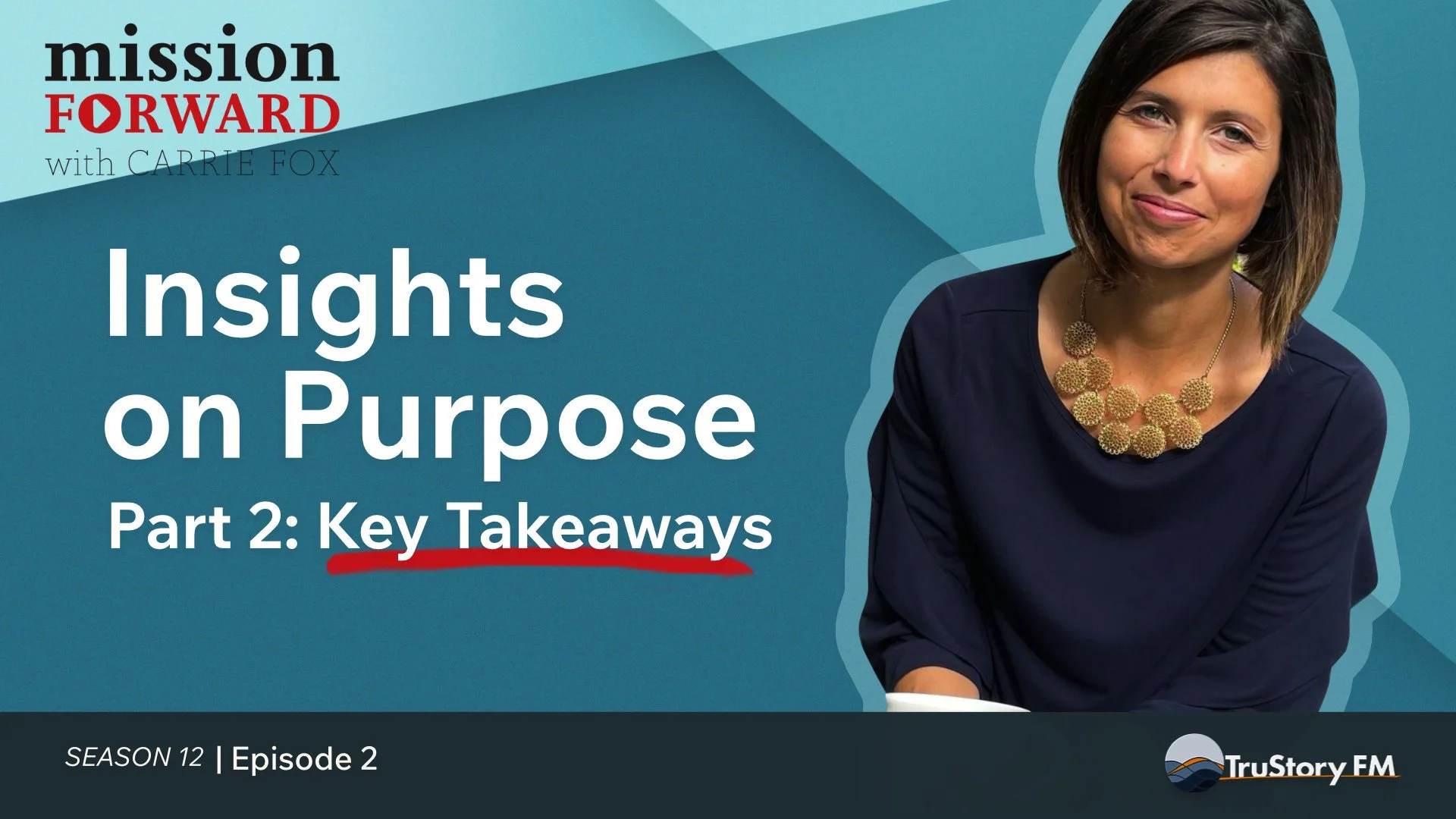
Something we've learned about good conversations is that they don't end when the recording stops. The best ones keep working on you — in the car, in the shower, in the middle of a meeting about something else entirely. That's the idea behind this episode, and behind a new format we're trying this season. After each full-length interview, Carrie is coming back with a shorter solo reflection — a chance to sit with the conversation, pull out what matters most, and share what's still turning in her mind. Think of it as a companion piece. The interview gives you the full picture. This gives you the underlines.
And there's a lot worth underlining from the season 12 premiere. In that episode, Carrie sat down with Stacy Palmer of the Chronicle of Philanthropy and Brian Fox of Mission Partners to dig into the 2026 Insights on Purpose™ report, a national study drawing on more than 400 nonprofit and foundation leaders. The findings are striking, and Carrie walks through the ones she can't stop thinking about.
What comes through most clearly in this reflection is something Stacy and Brian both named in the original conversation: that reports like this only matter if they spark real dialogue. Carrie closes by offering two questions for leaders to carry into their week.
Where do you need fresh creativity? And...
Who do you need to invite into the conversation?
They sound simple. They're not. And that's the point.
If you haven't listened to the full interview with Stacy Palmer and Brian Fox, start there. Then come back to this one. The two episodes are designed to work together — the conversation and the reflection, side by side.
-
Carrie Fox
Hey there and welcome back to Mission Forward. I'm Carrie Fox. So in this season, we are trying something a little bit new. After each full-length interview episode, I'm going to come back around and share what's sticking with me, what I'm learning, what I'm still thinking about, and the most important nuggets of wisdom that I don't want to lose in the shuffle of busy schedules and endless Zoom calls. Think of these as the Cliff Notes version of each episode. Or maybe Carrie's Notes, which feels a little more on brand. If you enjoy these short reflections, if they're useful to you, I would love it if you like, subscribe, or share this episode wherever you're listening. It helps more leaders find their way to the show and it helps this community grow. Okay, let's get to it.
Carrie Fox
So today I am reflecting on my conversation with Stacy Palmer, CEO of the Chronicle of Philanthropy, and Brian Fox, Chief Strategy Officer at Mission Partners. Together, the three of us kicked off season 12 by talking about our brand new 2026 Insights on Purpose report. A national research project that explores how nonprofit and foundation leaders are assessing their impact, their readiness for change, and the outlook ahead. And if you haven't listened to the full episode yet, I really do encourage you to go back and do that. Stacy and Brian help unpack not just the findings, but why we felt compelled to do this research in the first place. And why the stories behind the data matter just as much as the charts. Because what we're really trying to understand is not just what leaders are doing, but what it feels like to lead right now. And if you want to read the report itself, you can find that over at insightsonpurpose.us.
Carrie Fox
Okay, so here's the top line of my most recent conversation with Brian and Stacy. On February 4th, Mission Partners collaborated with the Chronicle of Philanthropy to release the 2026 Insights on Purpose report. It's based on survey responses and interviews with more than 400 nonprofit and foundation leaders across the U.S. And what we learned is honestly fascinating and also very sobering. The very forces that make nonprofits and foundations indispensable — things like economic pressures, widening social divides, political volatility — well, those are the same forces that are reshaping what it takes to deliver on mission. This, as we all know, is not business as usual.
Carrie Fox
And the data was worth digging into. Some of the biggest findings include these. First, leaders overwhelmingly describe the environment as harder than it was a year ago. And yet, they still believe their organizations can increase their impact over the next five years. Second, even though leaders talk about resilience all the time, there's a real gap between how resilient organizations look and how resilient they actually feel from the inside. Leaders told us they need to change how they plan and lead and innovate, but many aren't sure how. And as a result, a surprising number told us that they are operating without an active strategic plan. Fourth, nearly everyone knows AI matters, but most leaders feel behind the curve in using it. A new digital divide appears to be emerging in the sector, and it's worth paying attention to. And finally, while the missions of nonprofits and foundations are inherently linked, our research shows a relationship shaped by a fundamental lack of understanding. And if we don't address that misunderstanding, the gap between the sectors will only widen.
Carrie Fox
So these insights don't just highlight what's hard, they illuminate why this moment in social sector leadership is so consequential and why understanding it matters. That brings me to what I think is the underlying heartbeat of this report. It's this duality of this moment in leadership. Hundreds of nonprofit and foundation leaders unanimously described this environment as harder than a year ago. Pressures on funding, staffing, strategic planning, communications, technology. It's all real and it's all pressing. And yet, large majorities still believe they can increase their impact over the next five years. I mean, that's got to stick with you, right? Because what we're hearing is not naive optimism. It is purpose in action. These are leaders who are clear-eyed about what's hard and still anchored in meaning.
Carrie Fox
And Stacy and Brian both underscored something really important in my conversation with them. That this isn't optimism that pretends everything is fine. It's optimism that is rooted in the reality that mission-driven leaders don't have the luxury of giving up. And it's also a reminder. We cannot work in pressurized conditions forever. And we certainly can't do this type of work alone. We need peers and partners. Those are not nice to have. In these times, they're actually a survival strategy.
Carrie Fox
A second theme that stayed with me is the way leaders describe resiliency in theory versus how they describe it or experience it in practice. Almost everyone can define resilience, but far fewer leaders actually feel like their organizations have it. And that gap between knowing and feeling, that's telling us something powerful about the experience of being a leader right now. It tells us that resilience isn't just a buzzword, but it really does require that resilience become a daily practice. And it's exactly why community matters so much right now, because we don't strengthen resilience all by ourselves, certainly not in isolation. We strengthen our resilience with peers, with boards who understand the terrain, with funders who are listening really deeply, with teams who feel supported. And leaders told us that being seen and understood by others in the sector is in itself a resource. But it's a resource that's too often missing.
Carrie Fox
All right, one other theme that's sticking with me. We talked a lot about what happens when demand for services outpaces capacity. Something that nonprofit leaders are experiencing in real time. And it showed up in our data again and again. Foundations, as you might expect, in most cases feel steadier financially, whereas nonprofits are contending with rising community needs at a time when funding sources have shifted or dried up or become more competitive.
Carrie Fox
One of the biggest takeaways from the conversation with Stacy and Brian is the importance of rethinking the models we've relied on for years. Instead of assuming they can carry us through the next chapter, this is a good time. In fact, this is a great time for reimagination, for being open to creative solutions, for rethinking how we get from here to there. Because how we've gotten to here may not in fact get us to there. And when Brian talked about creativity in partnerships, in funding structures, even in how organizations are communicating value, he was naming a real strategic response to this complexity and something practical that organizations can take on.
Carrie Fox
Finally, I was struck by the emphasis that both Stacy and Brian placed on curiosity and understanding as real action steps for leaders right now. They didn't actually recommend tactical fixes that nonprofits and foundation leaders should take on, but they encouraged leaders to ask deeper questions. Of themselves, their boards, their teams, and each other. And that feels especially important when so many organizations still feel misunderstood by the very people they rely on.
Carrie Fox
Perhaps most importantly, they reminded us that reports like this one are only useful if they spark conversation. So, for those of you listening today, especially those leading a nonprofit or leading a foundation in this moment, here are two questions I want to leave you with. First, where in your organization might you need to lean into fresh creativity? Not to fix everything, but to expand your thinking on what's possible. And two, who are the people you need to invite into conversation this week? In a board meeting, in a staff discussion, or with a funding partner? To deepen understanding of the challenges and opportunities that you're both facing. These questions seem simple, but they're exactly the kinds of questions that convert the insights from our research into lasting and sustainable impact.
Carrie Fox
Okay, that's enough from me. I hope this reflection gives you something to carry into your week. And again, if you haven't listened to the full conversation with Stacy and Brian, I encourage you to take the time to do it. There is a lot more in that episode that is worth returning to. Next week I'll be back with a new interview, and this time we will hear from a foundation leader who brings many of these insights to life through her real experiences and powerful stories. Until then, my friends, thanks for being with us on Mission Forward.
