About This Episode
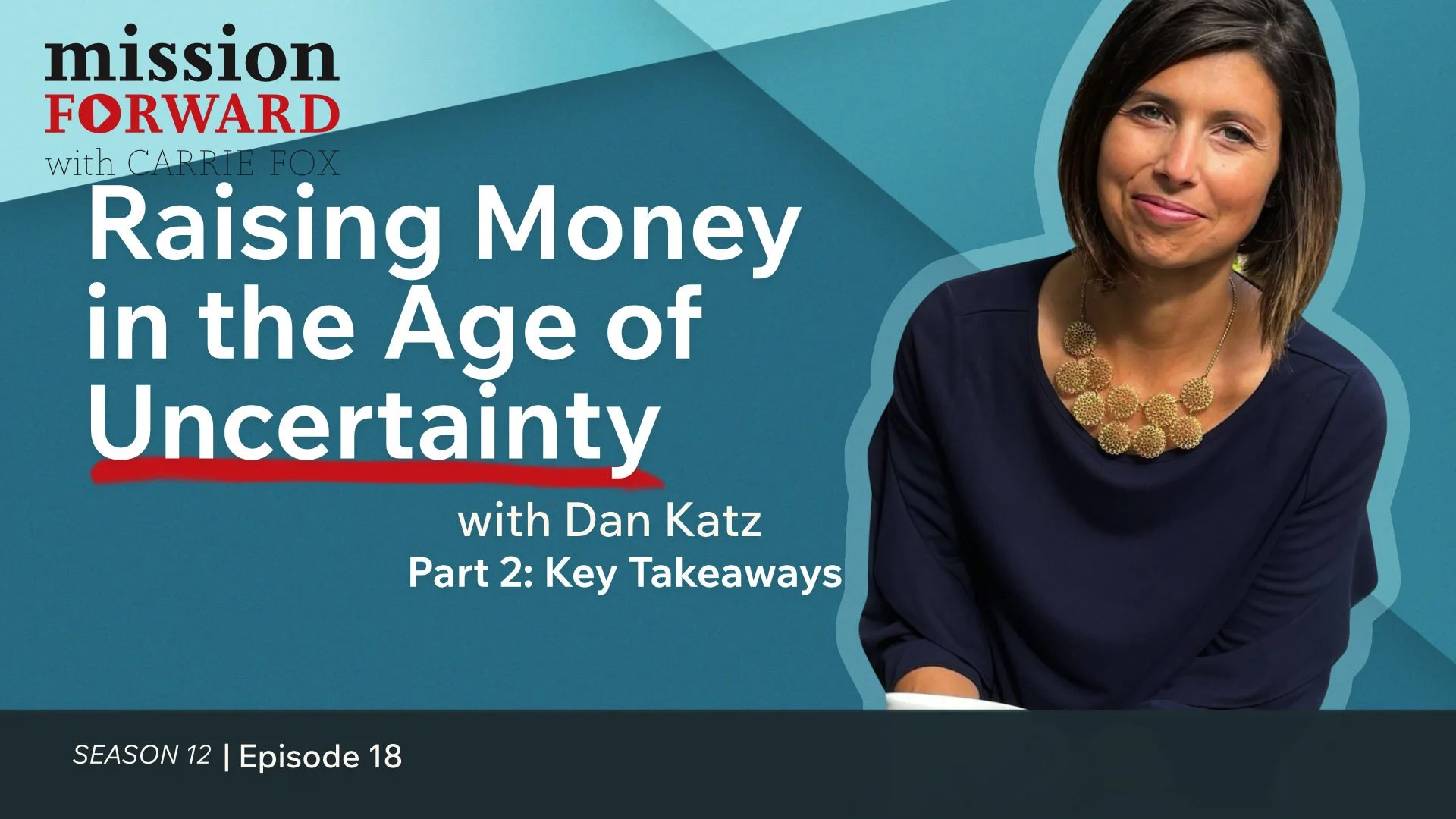
What do you hold onto when the ground keeps shifting? In this week’s reflection, Carrie Fox revisits her conversation with Dan Katz, founder of CIMA Consulting, and draws out three lessons for fundraising in what Dan calls an age of unprecedented uncertainty.
She closes on the idea that stayed with her most. As new tools make it easier than ever to write the grant and send the appeal, organizations are starting to sound the same, and donors can tell. Dan’s advice is to slow down, tell the truth, and be exactly who you are.
Links & Notes
-
Carrie Fox:
Hey, welcome back to Mission Forward. I'm Carrie Fox. This week I am reflecting on my conversation with Dan Katz. Dan is the founder of CIMA Consulting, and he has spent his career helping nonprofits raise the money that moves their missions forward. He and his team did it through the 2008 recession, through the pandemic, and now through what he calls an age of unprecedented uncertainty. If you haven't heard it, go back and listen to last week's show, because in a moment that feels so unsteady, Dan offers us a bit of a gift in this episode.
And it's something I think we all need more of right now. A steady hand. Here are my three top takeaways.
First, when there's no playbook, the fundamentals become the safe harbor. Dan started our conversation by looking back, right? We went back to 2008, when he talked about how we faced a financial crisis and how the answer for many nonprofits was financial intervention. In 2020, we faced a public health crisis, and people mobilized together, with money flowing to organizations that hadn't even asked for it. This moment is different, right? There's no shared agreement on the solution. For many organizations, the causes that they've given their careers to are suddenly harder to say out loud. So where do you stand when the ground keeps shifting? Dan says go back to the fundamentals. Get clear on your mission, your vision, and your values. Get clear on how your organization actually runs. Then build your fundraising on those things, right? Those fundamentals, he said, can be your safe harbor when the world around you feels uncertain. So here's my question for you. If you run or lead a nonprofit, if everything else fell away this year, would your team agree on what was left standing? Your mission, your vision, your values?
Second, invest in how you run and stop asking one person to do five jobs. Dan said something that every development director listening will feel. Too often, one person is asked to cultivate major donors, write grants, run the big event, and build the capital campaign. That is not one job. It's five, and it sets good people up to burn out. Resilient organizations take a different path. They've invested in their internal workings: how finance talks to development, how the board works with the executive team, and what staff and volunteers can expect. The work isn't always glamorous, he said, but it lets an organization respond instead of react. Dan put it really simply. Operational clarity is king. Donors want to invest in strong organizations, right? Ones that will still be there. So ask yourself, are the right people in the right seats, and have you given them a job that one human being can actually do?
Finally, build your revenue channels before you need them, one small step at a time. Many organizations have learned this the hard way over the past year, right? A federal grant disappears, or a longtime funder shifts focus, and suddenly that one channel they relied on is gone and they're scrambling. Dan's reminder here is both really practical and very hopeful. The story that resonates with your biggest funder is probably a story that other people want to hear too. Building a new channel doesn't take years of skills. You can test it, learn from it, even fail at it, and try again. The catch is the timing. The longer you wait, the harder it gets. So what's one small step you could take this month toward a new revenue stream that you wish you already had?
That's my reflection for this week, my friends. What stays with me most is something that Dan said almost in passing in our conversation. He said, as new tools make it easier than ever to write the grant, send the appeal, and reach donors, he worries that organizations are starting to look and sound the same. Donors are people. They can tell. So his advice is to slow down, especially now, when everything is pushing you to speed up. Be exactly who you are. That doesn't mean oversharing or getting sloppy. As Dan put it, it just means that it's okay to tell the truth. It's your story to own. The truth is what pulls people in.
All right, that's where we're gonna wrap today. Thanks so much for listening. Go back and listen to the full episode if you're interested, and take a look at CIMA Consulting's work. I'll have a link in the show notes. Until next time, keep your mission moving forward, and thanks for tuning in.
