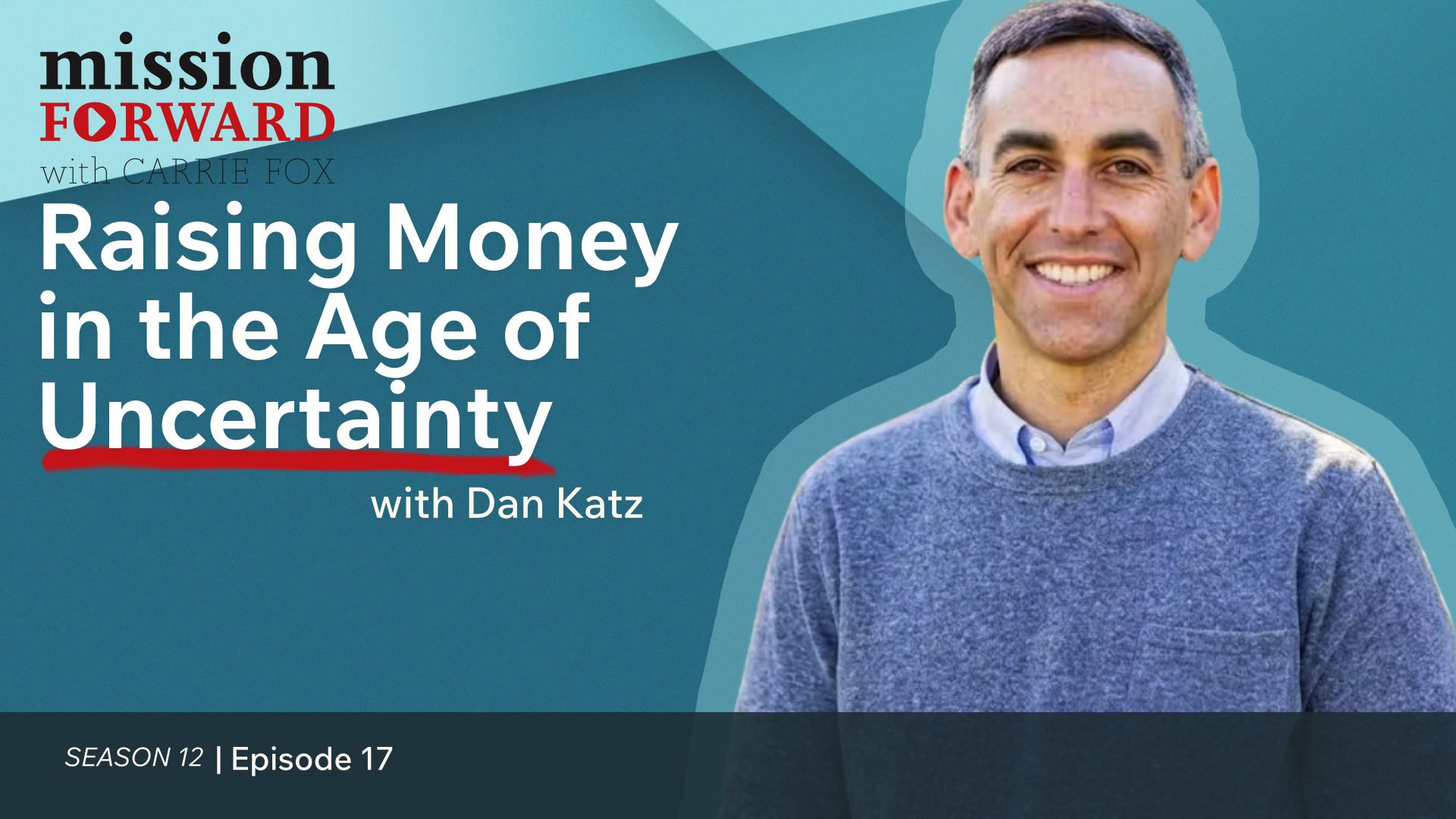
Raising Money in the Age of Uncertainty with Dan Katz
About This Episode
Some crises come with a playbook. In 2008, the answer was financial intervention. In 2020, it was a collective mobilization that sent money flowing to organizations that hadn't even asked for it. But the environment in which nonprofits are fundraising today doesn't come with such a playbook. There's no agreement on the solution, and for many organizations, the causes they've spent their careers advancing have suddenly become harder to name out loud.
Dan Katz gets it. As founder of CIMA Consulting, he partners with nonprofits in criminal justice, the environmental movement, reproductive rights, and youth services, and his counsel for how nonprofits can best navigate this moment is refreshingly steady: go back to the fundamentals. Get clear on mission, vision, and values. Invest in how the organization actually runs. Stop asking one development director to do five jobs. Build new revenue channels one small step at a time, before you need them. And when everything is pushing you to speed up, try slowing down instead.
That last point matters most as new tools make it easier than ever to look and sound like everyone else. Dan's view is simple: donors are people, and people can tell. The organizations that draw supporters in and keep them are the ones willing to be exactly who they are.
This is a conversation about staying calm in a crisis, and about the virtuous cycle that calm sets in motion. A grounded organization attracts staff, board members, volunteers, and donors who share its north star, and together, they can help carry it forward.
-
Carrie Fox:
Hi there, and welcome to Mission Forward. I'm Carrie Fox. For more than 25 years, I have worked alongside nonprofit and foundation leaders who do the essential work of holding communities together. And they're doing that often in moments of deep uncertainty. They, like you, are being the leaders that we need. But what happens when the moment needs more than we have? That's why this season we are going behind the scenes of our 2026 Insights on Purpose report. It's research that takes the pulse of hundreds of nonprofit and foundation executives across the country and asks a simple but profound question: how ready do you feel for what's ahead?
What we found in that research is striking. Leaders are under historic pressure, and yet many still feel confident about the future. Many still feel very confident about the future. And that tension, right, between concern and confidence, it's very real. And how to ensure sustainability in an increasingly competitive environment, that's very real too. Today we are looking at the fundraising environment, because I don't go a day without a conversation that ties back to mission. And if I'm honest, mission-moving funds and how to access them. Nonprofits can't do the mission-driven work they need to do without the funds. And yet there's this increasing demand for philanthropic funds and simply not enough to go around.
Right? So many nonprofits have started thinking differently about mission-moving resources, exploring new donor segments, fee-for-service offerings, and new strategies to engage the unengaged donors in their network. Today's guest, I am telling you, is going to be such a wonderful resource if that describes you. He's going to tell a little bit about what he sees working, how he's guiding clients who are nonprofits just like our clients, and how to navigate this time effectively. Without further ado, Dan Katz is our guest today. He is the founder of CIMA Consulting. CIMA provides institutional fundraising, development strategy, organizational strategy, and technology solutions to nonprofits, and I am just thrilled to have him with us today. Dan, welcome to Mission Forward.
Dan Katz:
Thanks for having me, Carrie. I'm happy to be here.
Carrie Fox:
Great. I'm happy to have you. So Dan, this season we have been asking folks to start by grounding us in this moment, right? You've been doing this work for a while, as have I. And we know that this time we're in, right, as we're recording this in 2026, feels very different than 2020. And so if you look back to that fundraising environment that was a fundraising during a pandemic, to now fundraising during just simply an age of uncertainty. What feels the same and what feels different to you?
Dan Katz:
For me, I also honestly went, uh, in thinking about this, I kind of go all the way back to 2008 and I, you know, reflected on the challenges of the recession, 2007, 2008, and then again in the pandemic, and what feels different to me. About 2008 and 2020. 2008 needed, you know, it was a financial crisis and it needed financial engineering and government intervention. And 2020, there was a global pandemic, and so there was a, you know, there was a public health intervention that required people to mobilize, and there was sort of a collective sense of urgency. And I think what feels different today is that there isn't necessarily concurrence about a solution. And some other things that occur to me that feel different is that in today's world there's many of our clients at least are feeling a different posture from the federal government. Perhaps some hostility from the federal government towards issues that they have spent their life advocating for, or their careers advocating for.
And so I think there's sort of some, you know, perhaps direct antagonism of certain issues like climate. Um, we saw federal programs being cut. And so I think that has led to what feels pretty different in this moment. And I think, you know, another thing that occurs to me in 2026 that's different than 2008 and even 2020 is just AI and the climate are two issues that are existential and problematic and there is no clear — there's no resolution. There's no endpoint to those that we can see today. And so then that leads me to what sort of in some cases is similar, is that people are fundraising almost in a crisis.
And I hope we get to talk a little bit today about ways to be calm in a crisis, I guess. And stability and what I think are, you know, fundamental truths that can be grounding for folks when they feel like there's so much uncertainty. Um, so those are things that I think stand out to me as both similarities and differences.
Carrie Fox:
And we are going to talk about calm in a crisis, so don't worry, we'll come back to that. Um, I really love the way you just phrased that. There was this collective sense to mobilize, and I remember that too. There was money flowing, particularly for organizations who weren't even asking for it, their money was flowing.
Dan Katz:
Yeah.
Carrie Fox:
To today, when we hear organizations simply say, my mission feels like it's become taboo. So that's tough, right? When organizations are thinking about, my values as an organization are under pressure and I don't know how to fundraise in this time. And so some of that comes back to how you remain focused on your North Star and advancing the work and calm in a crisis, as you said.
Um, there's some tough stuff to unpack for our development directors who are listening, and we see and recognize how difficult this job is in this environment. So how are you doing that? And maybe tell us a little bit more if you want to about CIMA and who you're primarily working with, kind of who inside of an organization you're working with. That might just help ground folks who are listening too.
Dan Katz:
I tell people all the time, CIMA means peak in Spanish and is not an acronym. And I think what we're all about is the fundamentals. We like to partner with organizations and understand what they do and why they do it and how to tell that story to the people who care about their cause or community. And so our focus is really on that mutual partnership, and our work is successful as a consulting firm when our clients see an impact on their cause or community. And so I think it's not a coincidence that you, as someone who even in the name of your organization is focused on mission, and we are talking because we care deeply about mission and vision and values. And our kind of focus and premise is that when you're clear on your mission and your vision, and they're rooted in your values.
It's easy to inspire hope, and it's easier — maybe not easy, but it's easier to inspire action and hope among your stakeholders of all types: your staff, your board, your volunteers, prospective donors, of course and even the people that you serve — and especially the people that you serve. Um, and so I think a lot about those fundamentals, and that's kind of how CIMA got its start, is sort of in what I think is a fairly straightforward premise that I just articulated about our North Star, is seeing impact and rooted in mission. And we've just been so privileged to work with really phenomenal organizations in the criminal justice space, in the environmental movement in the reproductive rights movement, in youth-serving organizations. And the needs are in some cases very similar and often you know, variations on a theme, but every organization is different, as you know. And so I think that's what is exciting and in some cases challenging about our work, is that we dive in deep and go as far and as fast and as long as our clients need us to, because that's just the nature of the work that we're doing.
Carrie Fox:
Yeah. Dan, your firm and ours both share many, many similarities, but one thing I've been talking about a lot that I see in your work is when organizations come to us and they just say, but we're stuck. We don't know how to advance in this environment. That we remind them that progress is always possible. It may not be on the path you expected to be on, but there's another path. There's another way. We can keep moving forward. Path may be slower, right? But you can keep moving forward.
And so I want to stick on that for a minute, because I mentioned at the top that organizational leaders say they feel like they are under historic pressure. And yet they feel like their organization is still going to make progress over the next five years. Right. So there's this distinction between how we as individuals feel. We feel tired, that's for sure, right? Having come through COVID and now coming into this time, but we feel confident about our organizations. And I'm curious if you are seeing that same thing show up, that kind of tension in your work, or if it's showing up differently from that fundraising-first perspective that you have?
Dan Katz:
Yeah. Well, I think the first thing I would say is that to each leader, each person working inside of a nonprofit — I see you, we see you. And I think people are tired, and this is hard work, and I think it's an especially challenging moment for leaders of nonprofit organizations. And it's inspiring to me that in surveys they're reporting that they still feel like they have hope. And, honestly, that's my first reaction to that, is that nonprofits have to traffic in hope and belief, and leaders have to be aspirational and they have to inspire others to action. That is inspiring in its own right, I think. And I do think that there is, you know, to some extent the nonprofit sector is almost being set up for a perpetual challenge, because it was never meant to hold as much as it's holding today.
And it's holding more and more. The social safety net is weaker today than it was when you know, many folks got into the work 10, 20, 30 years ago. And so I do worry, frankly, about that built-up pressure and the collective stress that many organizations are holding. And you know, I don't want to say that the nonprofit sector is being set up for failure, but it is holding more than it really was ever meant to. And I think in some ways, as a consequence, slower maybe to respond to kind of the latest and the newest in technology. There is sort of this David and Goliath paradigm that many, many nonprofits are kind of sitting facing an issue that is, I don't want to say intractable, but in many cases it can feel like they are up against increasingly more and more.
And so how do organizations feel hopeful, and why? It's not that they're irrational, I think. I think it's that many organizations began and live in their capacity to make a difference. In the immediate, right? And so they are experts in reframing in — what can we do today? And that's powerful. And I think that that is a resonant strategy in general for inspiring hope and action, is kind of staying grounded in the immediate.
And so that, to me, is something that I think really successful leaders and organizations are doing, is they're staying really focused on, what, you know, maybe we had a strategic plan and we've had to just put that to the side this year. And it can be for a number of reasons. It could be for, you know it doesn't have to have a single root cause. It's just there are many organizations that have done a good job of taking a challenging moment and reframing. And I think that that adaptability is really key.
Carrie Fox:
Yeah super. And you're making me think back to two other episodes I want to just make a connection to. A couple of years ago, actually, we had Iara Peng from JustFund. And she talked really eloquently about how nonprofits are not incentivized to invest in their own innovation. Right? You think about what percent of every dollar is going toward mission. Well, they're not incentivized to invest in their own strategies and innovation, which makes it hard for a nonprofit to navigate through uncertainty like this.
The other side of that is we had Tonia Wellons on not too long ago from the Greater Washington Community Foundation, and she talked about when crisis hits, or really any sort of uncertainty hits, then an invitation is also in that moment, which is an invitation to reimagine how you get the work done. And while the reimagination can be hard because perhaps we haven't built up those skills, right, we just do what we need to do every day to get those mission-moving funds in — that there is an opportunity to reimagine in a time of pressure. Right. So I want to go there. I mean, I know this audience loves really practical tips and insights, and you all do that work so well.
What do you see that's working for organizations who are at this crossroads of, how do I navigate through this in my fundraising strategy?
Dan Katz:
This work is incremental, and so I would encourage folks to recognize that one positive lasting or seemingly lasting step is progress, and you can't get to where you want to be long term immediately. And so I think good leaders have that long-term perspective and are focused on executing short term. I love thinking about investing in process, getting clear on the capacity that's needed and why. You know, I think donors want to invest in strong organizations. They want to invest in missions that will be there. I think what's not super well understood is that most nonprofits are actually quite small. And the nonprofit sector has grown tremendously again, due to the need, and demand is only gonna go up. I think what's working is organizations that invest in those fundamentals.
And the fundamentals are aligning on mission, vision, values, getting clear on your process, getting clear on how you run your organization, and building fundraising strategies that are rooted in those two fundamentals. And I think in a moment of crisis, being as clear as you can be on your fundamentals, it is hard but necessary. And I think that those fundamentals can carry you and can be your sort of safe harbor when the world around you feels uncertain.
Carrie Fox:
And so what I'm hearing in those words is, the fundamentals is doing those little things well. And literally the little things sometimes are the big things, right? So I got an email just last week from an organization that was asking me to make a donation before midnight. They had a deadline that was going to run out, and it said in the headline — or I'm sorry, in the opening of the email — it said, Dear parentheses, Stephanie. Well, I'm not Stephanie.
Dan Katz:
Yeah, yeah.
Carrie Fox:
And the parentheses to me signaled that was probably a form that they forgot to update. So those little things really matter. Get the process down.
Think about who's doing what. How you're making sure that you get those connections right, because what I've learned — and you know — is fundraising doesn't go very well if you're not really focused on the human side of that, making that connection, right?
Dan Katz:
Absolutely. And, you know, I think authenticity is something that I really strongly preach just personally within my organization, and then I try to encourage our clients to understand that donors, institutions, they're all people. And so it's all about making that connection to a person authentically. Uh, you know, I think in an age where perhaps board members or executives are looking at tools that make it easier to submit grant applications or to connect to individuals en masse, there's a tendency then, I think, to sort of look and sound the same. And donors are smart people and they are gonna pick up on that.
And so I actually think that there's maybe even the need to slow down is even more pressing today when we're being kind of pushed to speed up, because you risk losing your identity and your voice, and you risk losing what's resonant to your stakeholders if you outsource the deep thinking, the connection to people, the connection to community. And in fact, as we've kind of grown into this sort of quasi-remote, bifurcated society in some cases, I think people are really desperate for connection, you know, and we're seeing that in our clients, we're seeing that with their donors, we're seeing that in our personal lives. And so if I had one message to share, I think that that would really be it. And hopefully that's easy for people, because the message is basically just be yourself, be who you are as an organization, because whatever led you to the place that you are today, there was some — it wasn't out of a desire to to make money, right?
Or at least that wasn't the sole motive. And so leaning into that deeper motive is, I think, quite compelling. And there's a tendency to want to put a sheen on things with today's tools. There's almost like a parroting in the nonprofit sector of what they see happening sometimes in the sort of broader society or in the corporate sector. And I like to encourage folks to just be who they are. And it, that doesn't mean overshare, it doesn't mean be sloppy in your communication. I think it just means it's okay to tell the truth. And in fact, the truth is often what pulls people in, and it pulls them in long term, I think.
Carrie Fox:
Yeah. So tell us a little more. Maybe paint us a picture of what a — whether you think about it as a high-impact organization or a high-functioning organization. Maybe it's even a high-functioning fundraising department — looks like in a time like now, right? Like, what kind of elements are in their strategy? How are they leaning into learning, particularly in this AI environment? What are the elements at place when you think about those high-functioning fundraising departments?
Dan Katz:
Resilient organizations are organizations that are responsive, not reactive, and they've spent time thinking about how they really want to operate. They've spent time on the internal functioning of their organization. Unfortunately, I think a lot of organizations start, and there's a compelling and, uh innovative leader with an interesting idea, and maybe they've grown in an ad hoc way. And I think resilient organizations have over time invested in some of that process. And they've thought about, how do we coordinate across operations and finance? And how do we coordinate between finance and development?
And how do we coordinate between the board and the executive team? And what are our communication norms, and what can our staff expect from us? What can our stakeholders and volunteers expect from us? And how do we know that we're executing on that? And they've spent time thinking about those things in a responsive and thoughtful way. And I think that allows them to know when to jump and when not to jump, and when to push their team and when to support their team. And, yeah, it's a marathon, right? And that's a cliche, but I think it is very much true.
I think one of the realities that we see all the time is that people burn out. Nonprofit staff turn over, especially in the development side of things, quite often, and keeping those staff members motivated and oriented, I think, does — you know, it's not a quick fix, but I do think operational clarity, governance, financial discipline are things that help you run a better organization, and they resonate with donors. And so it's sort of a win-win. It can seem hard to invest in those processes when you're in the midst of a crisis, or what feels like a crisis. And I think that's where I'm a big fan of just incremental sort of immediate — what can you do today that's like one positive thing?
Carrie Fox:
Yeah. So, you can't fault me for this because I'm a communicator. I hear communications in every answer. It's just the way my mind thinks. So when I listen to you, I hear things that are critically important are alignment across an organization and open lines of communication, right? Without those things, it makes it really hard to move the ship forward. And I was talking with a pair of folks last week, a VP of advancement and the president of a university. And I said, you know, every time I see you two together, it is like a dream team, right? You finish each other's sentences and you're just in lockstep.
And I know that they are as effective as an organization because these two people are in lockstep. And so maybe some guidance for folks listening is just to take a pause and make sure, are the right people in the right seats to be advancing this mission together? Because when you're not in alignment, when you're not in lockstep, you're already starting from, you know, behind the starting line, right?
Dan Katz:
Absolutely. And I agree with you wholeheartedly that communication is absolutely essential. And to the point about folks being in the right seat: I do see that a lot of organizations hire reactively, or their process for hiring may not be as careful as it might otherwise be, and they're adding staff without considering sometimes, is this really the right person? Are they really oriented towards our culture, right? And many times — and I'm speaking mostly on the development side — we see a lot of development staff that are being asked to do five different things that are really not a single job, and they're being pulled constantly in different directions.
And so one thing that good organizations do is they get that fundamental truth, and they find ways to put people who are — let's just say if you're a major donor fundraiser, they put that person in that seat and they don't ask them to write grants. And they don't ask their development director to do a big event, major fundraising, build a capital campaign, and also write grants, because those are just — there's just too much for a single person to do. And I think that that's kind of a common — we see it all the time, people are asking a single person to do a multitude of things that are honestly not well suited, often, to a single person.
Carrie Fox:
So stop asking your development directors to to do more than is humanly possible, right? We're setting them up for failure, right? If we're not maybe being clear in what that development director can do, where their greatest skills and talents are, lining that up, making sure they're in the right seat. So I'm hearing a lot from you around that organizational process really needs to work before you can even make the ask for funds.
Dan Katz:
Yeah, totally. And we're hearing a lot, and we're doing as much as we can to share what we've learned on revenue diversification, because that's another thing that we're just hearing you know — and I'm sure you're hearing as well frankly — is in the face of maybe a big federal funding cut for an organization, or a big longtime donor that has decided to shift focus folks maybe have overemphasized what has worked for them on the revenue side of things. And that could be, you know, it could be institutional funds, it could be a major donor. And what I think good organizations are doing is recognizing that the fundamental truth of whatever is resonating with the big major donor or the big foundation partner is likely a story that you can tell to other stakeholders. And if you take incremental steps to build those other channels of revenue, you can hedge your risk faster than you may think.
And those kinds of things are incremental. And the longer you take to build that diverse revenue pipeline, the harder it gets. And so I would try to encourage folks to recognize that if they're raising money today and they feel like they are too dependent on a single revenue channel, it's not too late to branch out. And it isn't a skill that you have to develop over years. You can iterate and you can test and you can, frankly, fail even in building a new revenue channel, and learn, and decide to go elsewhere.
Carrie Fox:
All right, somehow we're at the end of our time, but I gotta ask you another question. And first now I'm seeing very clearly this through line. You have touched on calm in the storm in many of your answers today, right? This importance of being calm in a crisis. But anything else you want to look back to on why that is so important right now, or any guidance you would give to folks who are listening on how to be that calm in a crisis?
Dan Katz:
I'm a big fan of clear and simple strategy, and you know, we run our organization on pretty straightforward values and goals on an annual basis. And so I would encourage organizations to think about big directional goals rooted in values as being highly motivating to staff. I think that operational clarity is king. And so good organizations are — you know, some of our most successful partnerships have been with organizations that have taken the time to invest in operational clarity, which to me is mission, vision, values. Clear communications — and I'm not just saying that because I'm talking to you, Carrie — um, and an ability to execute in the immediate, which again is about motivating action among board staff, donors, volunteers. It can be a consistent message. And so I think those are things that have worked and seem like they will always work. And in a moment where people's words are being kind of commodified and homogenized.
It's powerful to know what is true for you and to adhere to that. And surprisingly, it's not as common as I think it should be.
Carrie Fox:
It's hard to trust someone who comes across as frenetic, just like it's hard to trust an organization that comes across as frenetic. And so to be that calm in a crisis, to be really grounded in your values, your mission, your vision, to believe in your mission and to portray that out into the world, will help others believe in your mission too, right? So avoiding that frenetic feeling, even if it's the way you feel, trying to model that calm, which, to your point, right, will ultimately have people trust and want to be more invested in where you're going.
Dan Katz:
I think it's a virtuous cycle, because it attracts staff, board members, volunteers, donors who also have that same orientation. And so then as you build a team of people, or as you kind of add members of that bigger community who are oriented around, you know, what for you is your North Star — that's a virtuous cycle. Those are people who are kind of filling up your cup, who are chipping in in ways that you need them. And it's because that's the reality. Nonprofits are in a resource-constrained environment, I would say, right now. And so those are things that will help you of course, yes, financially, but I think they'll also help you spiritually, and in your sort of, in kind of building the will to continue.
Carrie Fox:
Yeah, that's great. Well Dan, I said we had a certain amount of time. We blew past that, and that's all right, because this was such a good conversation. And thanks for being so open to thinking really big about the work that you do and how you guide clients. And thinking back to where we started today, right? There's a desire to solve the near-term problem, which is, how do I close these gaps? There's also an opportunity to think really big about how do I reimagine how I even deliver on this work that will bring more people along with me. So thanks for helping us reframe that and stay grounded in that today.
Dan Katz:
Thanks for having me. I loved — I love chatting with you.
Carrie Fox:
All right. Thanks, Dan.
All right, and that brings us to the end of this episode of the Mission Forward podcast. You know, I had this vision in my head as Dan was finishing up today, and it's back to an editorial cartoon that I saw many years ago. I mean, honestly, it was probably 2008. And it was this cartoon of a nonprofit leader with a foundation leader. And the foundation leader says to the nonprofit, what's your mission? And the nonprofit leader says, whatever you want it to be. And what's interesting is I feel like we're in that process again, right? That we are all trying to chase after the resources we need to do our mission. But we may not be chasing after the resources that we need to do what we need to do. And so Dan's message to us today: to stay aligned.
To have those open lines of communications, to be grounded on our mission, vision, values. While it may sound like that's not development work, well, it is, right? Because the more we are aligned in that mission and why we exist and how we do it, the more we can pull and bring those donors along with us, including expanding our network to new donors who believe in our work. So keep at it. We are so humbled to do the work that we do in service of exceptional development directors, communication directors, nonprofit leaders, and board members every day. And I hope you found this conversation as helpful as I did in continuing to think about how to move the mission forward. Until next time thanks for being with us on Mission Forward, and we'll see you soon.
