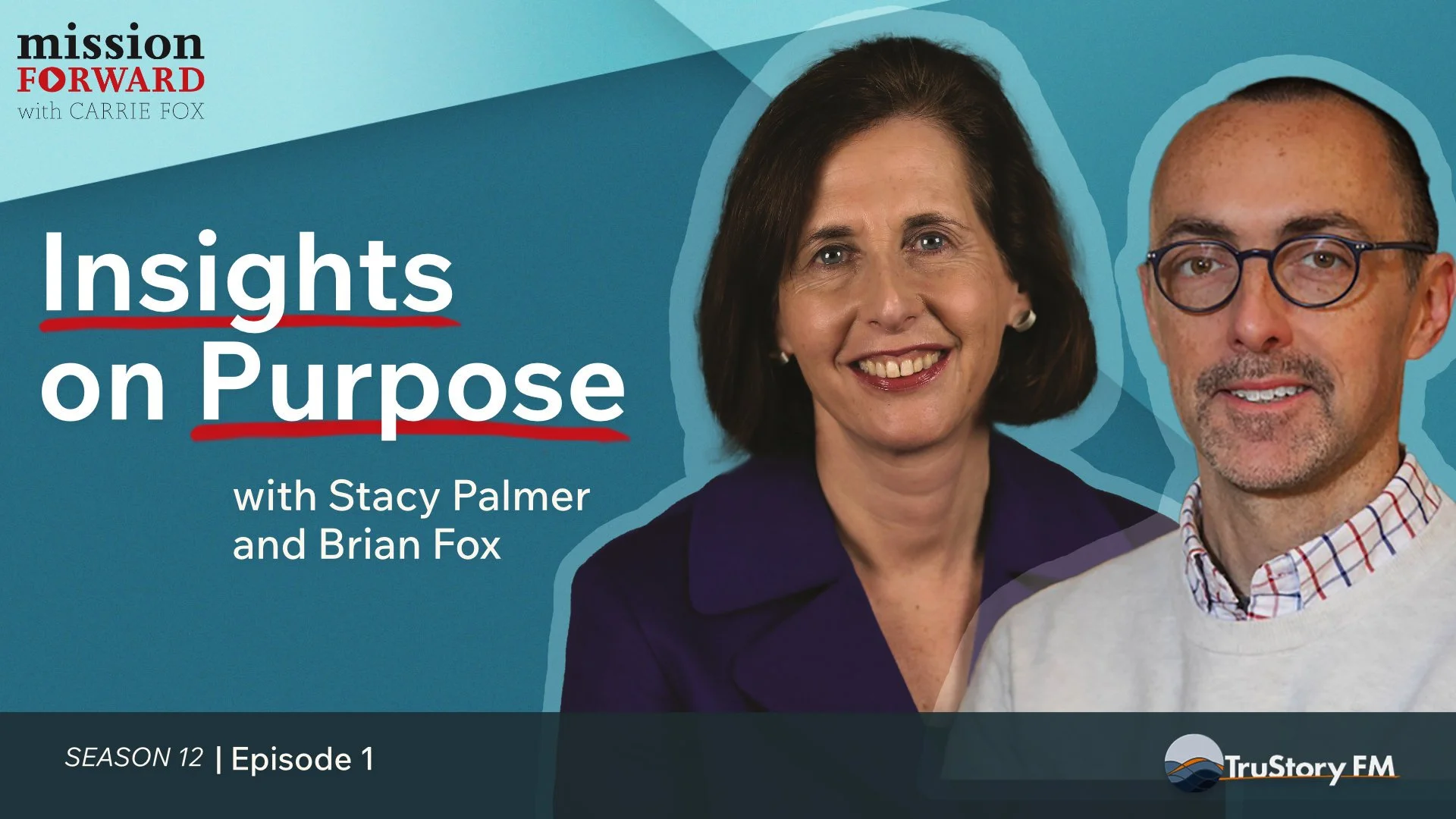
Insights on Purpose with Stacy Palmer and Brian Fox
About This Episode
What if the defining feature of nonprofit leadership right now isn’t burnout or bravery, but a kind of double vision—an ability to stare straight at worsening conditions and still believe, perhaps stubbornly, that impact can grow?
As we launch season twelve of Mission Forward, Carrie Fox sits down with Stacy Palmer (CEO of the Chronicle of Philanthropy) and Brian Fox (Chief Strategy Officer of Mission Partners) to unpack the 2026 Insights on Purpose™ Report, built from interviews and a national survey of nonprofit and foundation leaders.
The numbers land with a thud: nearly everyone says the environment is harder than it was a year ago, and yet large majorities still think their organizations can increase impact over the next five years. This is not optimism in the syrupy greeting-card sense. It’s optimism as a job requirement—paired with a private ledger of worries about cash on hand, staff departures, restructuring, and the creeping sense that “resilience” is something we describe more easily than we actually feel.
So this week, we look at what nonprofit and foundation leaders are really carrying right now—what they’ll say out loud, what they’ll admit in private, and why the gap between those two versions matters. This is the story of confidence and strain living in the same institutional body. About “resilience” as something everyone invokes, but fewer people can define in a way that survives contact with payroll, boards, and the calendar. About why planning feels harder when the ground won’t stop shifting—and why the answer probably isn’t a bigger plan, but a different relationship to planning altogether.
If you’re leading an organization, funding one, serving on a board, or simply trying to understand why so many leaders sound calm while feeling anything but, this episode gives you a lens—and a few powerful questions worth keeping close. The report, in their telling, isn’t a stack of charts. It’s a set of voices—unfiltered—trying to say what’s happening before the sector pays for it in closures, mergers, and communities left without the organizations they rely on.
Our great thanks to the Chronicle of Philanthropy for their partnership in bringing this report to life. We hope you’ll take the time to read and share it broadly.
-
Carrie Fox
Hi there, and welcome to Mission Forward. I’m Carrie Fox. For more than 25 years, I have had the privilege of working alongside nonprofit and foundation leaders who are doing the essential work of holding communities together, often in moments of deep uncertainty. And they, like you, are being the leaders we need. But what happens when the moment needs more from us than we might have? That’s why we’re here today.
This season on the Mission Forward podcast, we are going behind the scenes of our brand new 2026 Insights on Purpose report—research that takes the pulse of nonprofit and foundation leaders across the country, and asks a simple but important question: How ready do you feel to meet what’s ahead?
What we found is a striking duality. Leaders are facing historic pressure, and yet many still express confidence about the future. That tension—between concern and confidence, and how to lead through it—is the space we will be exploring all season long.
To open the season, I’m joined by two people who helped shape and deeply understand this research. Brian Fox is Chief Strategy Officer of Mission Partners, and together with our research team, Brian led the design and analysis of the Insights on Purpose report. And Stacy Palmer is the CEO of the Chronicle of Philanthropy, who has been an important partner to us every step of this research journey. Stacy’s deep understanding of the sector has long helped nonprofit and foundation leaders make sense of moments just like this one.
Together, we’re going to talk about what this research reveals—not just about the sector, but about leadership itself—and what leaders like you can do starting right now to keep moving your mission forward. Brian and Stacy, welcome to Mission Forward.
Brian Fox
Thank you. It’s great to be here. Great to be here with you, Stacy.
Stacy Palmer
Thrilled to be here with you.
Carrie Fox
I have been wanting to conduct this sector-wide research report for a long time, given the signals that I’ve been hearing and feeling since 2020. And Stacy, I know you’ve felt the same way. It’s why we’re doing this together, and I was thrilled when our organizations decided to partner on this effort. Why did conducting this research intrigue you so much?
Stacy Palmer
I share your interest in doing all of this. One of the things this field has a real paucity of is up-to-date information from real people telling us what’s happening. In this moment, when nonprofits and foundations are more challenged than ever, we need to know everything we can about what’s going on, what’s happening, and how we can all work together better.
So when you suggested this idea that we do some kind of pulse poll and get it out to the field as fast as possible—do the work in the fall, get it to people in February, which in this field is very fast—I was absolutely delighted. That way we have really up-to-date insights of what’s happening, both with nonprofits and foundations, and that will fuel decision-making, debate, and the kinds of conversations we all need to have.
Carrie Fox
And it’s one thing to have an idea. Stacy, you and I have a lot of them. It’s another thing to implement such a massive, really first-of-its-kind research survey. So Brian, tell us a little bit about the report itself—how it was conducted, some of the methodology, etc.
Brian Fox
Sure. Through the research, we connected with over 400 nonprofit and foundation leaders, and the research included two phases: a qualitative phase and a quantitative phase.
In the qualitative first phase, Mission Partners conducted about 23 in-depth interviews with nonprofit and foundation leaders. Those occurred, timing-wise, August 28th through September 12th of last year. We set about those interviews because we wanted to help inform what we were going to ask in the quantitative phase.
In phase two, our quantitative phase, we conducted a survey of U.S.-based nonprofit and foundation leaders. That was fielded from October 1st through October 27th. The sample of the survey is really interesting: 80% of respondents were CEOs, presidents, or founders, and the rest of the participants were at the C-suite, vice president, or senior director level—so really high-level leadership positions in these organizations.
The sample survey covered a wide range, and we think a well-balanced U.S. geographic representation, as well as a range of concentration areas for those nonprofits and foundations. And lastly, the nonprofits in our sample had an annual operating budget ranging from less than $1 million to over $50 million. On the foundation side, annual giving ranged from less than $1 million to more than $50 million.
Carrie Fox
What I’ll reinforce—and you just said this, and I also mentioned at the top—is about this duality: this is a report about nonprofit and foundation leaders and what they’re each experiencing. There is this striking duality mentioned in the report—leaders facing pressure while expressing confidence.
So what do each of you see behind that tension? Why is that such a defining feature of this moment?
Brian Fox
Behind the tension, I see exactly the kind of leaders you’d hope for. On one hand, these leaders are incredibly dialed into the realities of the past year and this moment. Leaders of nonprofits and foundations nearly universally observe a really harsh environment.
Our research points to 87% of foundation leaders and 97% of nonprofit leaders indicating that, compared to just one year ago, the environment for their organizations is becoming somewhat or much more challenging. In leadership, you need people who can call it like they observe it. There’s no benefit to sugarcoating the challenges. Doing that just sets you on a path for increased difficulty in managing the situation.
At the same time, on the other hand, there’s this confidence you mentioned: despite the challenges, there’s confidence in their ability to weather the next several years—our survey focused on the next five years—and actually more than weather it: to increase impact over the next five years. It was fascinating. Seventy-eight percent of nonprofits and 93% of foundations think there’s capacity to increase impact.
Leaders, by their very nature, are not defeatist. They project, “We’ve got this. If we band together, we can overcome it.” And I see that shining through in the data.
Now, I would concede it’s never as easy as willing oneself to overcome obstacles, and there are certainly some cracks in the confidence that we’ll get into. But it’s defining this moment because you see acknowledgement of the seriousness of the moment, and the defiance you’d hope to see in response to it.
Stacy Palmer
We always see nonprofit leaders go into this work because they’re incredibly optimistic about what they can do. So the fact that this has not defeated them—that they’re going to keep moving forward—is really remarkable, but perhaps not surprising.
Another thing we started thinking about is how many of these folks have probably experienced real threats. You can think—obviously—COVID was one of them. Sadly, a lot of nonprofit leaders after COVID did decide it was time to quit. But the last time we had a real moment where lots of nonprofits closed and couldn’t do things was more during the Great Recession. That’s a long time ago. So many of these organizational leaders have not been through the worst of the worst, and I think that can make them more optimistic.
I’m somebody who led during the Great Recession, and it scared the hell out of me when things started happening, because I felt some of those same signs. But if you didn’t have to endure that, you saw that your organization was really innovative during COVID. Some good things came out of it in terms of our ability to do things online, be more flexible in how we treat employees, and all of those kinds of things. You might look at it and say, “It’s going to be rough, but I can see some of the upside.”
And I think the fact that we’ve got AI coming that could ease some burdens—on administrative work and other things—means people do see that, even in this really rough time, there are opportunities to rethink how we do things. I’m not sugarcoating anything, and neither did they, but there are opportunities. So I think that’s why we see incredible optimism.
Carrie Fox
Let’s talk about what feels like a buzzword: resilience. There were quite a few nonprofits and foundations in this survey that noted they agree on what resilience is, but nonprofits report being far less confident that they actually have resilience. What’s interesting is it’s one of these signals: I hear more leaders now talking about durability—building durable systems versus resilient systems.
I’m curious, and maybe Stacy, we start with you. What is this gap in terms of what we say we have versus what we feel or actually have? What does that tell us about how leaders are experiencing resilience day-to-day versus how they talk about it publicly?
Stacy Palmer
How they talk about it publicly is very different than how they talk about it privately. That’s what I love about this survey. People didn’t have to disclose their names, and they probably told us more about how they actually feel.
A lot of nonprofit leaders are really worried about cash on hand—what are they going to have? Are their employees going to burn out and leave? And you don’t really want to talk about that publicly.
For foundations, they have tremendous assets, and they have more ability to control their destiny. Now, it depends what their founding document said, and whether they have the freedom to go into new areas—to think about things like spending all their assets, not just increasing payout, but considering spending down. But they have more in their control, certainly, and so it makes sense to me that they feel much more resilient.
Their question is, “Where can I do the most good? Where do I make a difference?” That’s not an easy thing to answer, but they know they have power over that.
Nonprofits have to persuade foundations, individual donors, or come up with earned income programs, and all of those kinds of things. None of that happens in a minute. You don’t snap your fingers if you’ve never raised money from individual donors and suddenly do it. You might know it’s smart to do, but you can’t do it in a second.
So I think some of it is how well prepared organizations are. A piece of resilience is: what did they do before all of this stuff happened so that they were ready for it? Those who did scenario planning—thought about the fact that things could get really rough—are in much better positions, and they’ll probably say they’re more resilient than those who didn’t know this was coming.
Brian Fox
The research points to the fact that there is a common view among nonprofits and foundations as to the factors contributing to organizational resilience—things like leadership, team culture, staff commitment, and, importantly, what Stacy elevated on the financial side.
The problem is that these are elements under significant pressure across the board, particularly among nonprofits. We have 70% and 60%, respectively, of nonprofits and foundation leaders saying they’re worried about their staff burning out, retiring, or leaving for other jobs in the next 12 months. That feels very different than the confidence we just spoke of—leaders weathering the storm and increasing impact—that we see elsewhere in the data.
Another data point from the report that struck me: 37% of nonprofits seriously considered a major restructuring in the past 12 months. Again, that feels at odds with the confidence elsewhere.
So what does it mean? It tells me there’s an early indicator light on the dashboard glowing—if not flashing—in this moment. The car seems to be operating just fine, and we may even want to believe the car is operating just fine. But under the surface, there are fundamentally troubling issues that need to be acknowledged and confronted for nonprofits and foundations to succeed in doing their work in our communities.
And it’s particularly tricky. This challenging time is not the moment you want to be experiencing these challenges related to team, culture, and resilience overall.
Carrie Fox
There is a reimagination happening. Whether that reimagination is required—being forced upon organizations—or whether organizations are seeing what’s ahead and getting ahead of it, we’ll talk about strategic planning in a bit.
That is one of those signals, Stacy, that I mentioned seeing in the past. I saw it during the Great Recession. I saw it during COVID. There is an opportunity to reimagine how we do things. There are always opportunities to change and improve. It’s a matter of: are we doing it because we have to, because we’re under pressure to do it, or are we getting ahead of it?
This next question speaks to that because one of the most sobering findings in this report is this disconnect—and it is a growing disconnect—between the rising demand on nonprofits and their capacity to respond. If there’s a lot of demand on you, it’s hard to be reimagining something, certainly in the moment.
So I’ll toss this and see who wants to take it: what are the risks if that gap continues—rising demand, decreased financial capacity? What do you see as a promising opportunity to try to close that gap?
Stacy Palmer
Let me reinforce your concern about what’s happening and what we saw in the data. Some of the legislation that was passed this summer will cut things like Medicaid spending and really hit people very hard. We know we’ve already seen increased demand. Nonprofits are going to see even more of it as governments are forced to pull back because of some of these funding issues.
Now, it’s possible some of that will be reversed. One of the interesting things is that Congress is not going along with some of the cuts that the Trump administration proposed in science, the arts, and other areas. So we don’t know for sure what’s going to happen.
But all the signs are that the demand is going to increase exponentially, and it may outstrip what foundations can do. Foundations are going to need to step in and think about where those areas are, and it might be areas they haven’t funded before. They need to think about who’s going to be harmed by some of these losses and pullbacks, and which organizations really need to be shored up.
Some organizations may need to merge. With demand like that, we can’t keep operating the same way. It’s time to rethink the model, and the unfortunate part is we have to rethink it really fast. Nonprofits aren’t always good at that.
The best thing foundations and donors could do is support that effort of rethinking, because it really needs to happen.
Brian Fox
Stacy is completely right. The data from our report suggests that 83% of nonprofits expect to see increased demand for services and programs over the next five years. That is striking against the financial challenges the data also suggests.
When we asked about financial health, just 55% of nonprofits responded “excellent” or “very good” from a financial health standpoint. Foundations are much better off—94% is what we saw there.
Driving a lot of that is what Stacy was alluding to. You’ve got challenges related to federal funding. You’ve got 51% of nonprofits indicating a loss of a major funding source in the last year, and 68% indicating a minor funding source lost in the last year.
So if that gap continues, the risk is that otherwise strong nonprofits just won’t be able to survive, and the communities they serve will suffer. It’s as straightforward as that, especially as demand is soaring.
Opportunities to close the gap start with understanding, and then being willing to get creative together. I actually think the Chronicle has done some interesting reporting recently on the creativity needed to meet this moment. It’s not enough to know there are financial challenges. There needs to be real conversation about why, what the circumstances are, and what the vision is, so there can be ideation on the right tools to bring to the moment.
Carrie Fox
Stacy, let’s talk about that reporting. We know from the research foundations are saying they are feeling steadier in many cases. But when you think about what you’re hearing and what you’re reporting out, how does this finding—that foundations are actually feeling steady and increasing giving—align with what you’re hearing from foundations right now?
Stacy Palmer
Foundations have incredible assets. Assets grew by $150 billion last year. Their resources are quite high, and they’ve been steadily increasing. You watch the stock market growing—foundations have plenty of assets to think about giving. So they’re thinking about how they can deploy them.
Some of the creative ones are thinking not just about how to increase giving, but what other things they can do for organizations. One thing some foundations are doing is pooling money and putting it into a fund that can offer bridge loans to nonprofits that maybe lost some of their federal funding.
We all know government takes a really long time to pay, even in the best of circumstances. Organizations supported by states, cities, and those kinds of things often know the money is coming, but they don’t have it right then. So bridge loans are one approach.
Those are expensive, and you don’t necessarily want to do them all the time, but that idea of using the full set of assets is important. Foundations come together, use their influence, think about their entire portfolios, and ask: is this the time to loosen up our purse strings and give even more, and recognize this is the moment to do it? Hoarding is not important at this moment. We need to get the dollars out the door.
Those foundations that do that are making a difference. There just aren’t enough of them for nonprofits to feel that foundations are really coming to the rescue. But there are some.
Carrie Fox
I love that comment about influence, because not every foundation is a global foundation with unlimited resources. Some foundations are limited, but this idea that they can use their influence to bring other small or medium-sized foundations together and invest in something more meaningful has been inspiring. I’ve been really inspired by the efforts I see there—collaborative philanthropy responding to this moment.
Brian, let’s turn to strategic planning. Many leaders in this research report say long-term planning feels harder than ever. Some are operating without a strategic plan at all. That’s tricky: needing reimagination but not having a plan on how to do that.
How should leaders be thinking differently about strategy when the ground keeps shifting beneath them?
Brian Fox
It’s a great question. Just for context: compared to last year, 61% of nonprofits indicated that strategic planning over the next five years is somewhat or much more difficult, and 53% of foundations said the same. It’s a hard time to be forecasting and planning.
First, if you’re one of the three in four foundations or nonprofits that has a strategic plan, hopefully you’re actively using it and updating it on a regular basis—perhaps quarterly or even monthly at this point. At Mission Partners, this is something we do with our own strategic plan, and it’s how we counsel clients to think about utilization.
As part of that active use and updating—or if you’re one of the one in four that doesn’t have a strategic plan and you’re thinking about creating one—I would encourage organizations to focus on having a one-year action plan based on the current environment. Focus on specific steps you can take in the near term to secure the longer term.
As part of that, I’d encourage organizations to think about whether they have crisis response plans in their organizations or within their strategic plans, so staff know what to do and how to manage situations as they unfold.
And lastly, as hard as it might seem, try to observe the shifting ground as opportunities. We see about half of foundations reconsidering which grantees are best to advance their mission in the last year. That can be frightening or daunting, but nonprofits can view that as a signal to proactively check in on mission alignment with funders. Consider what parts of your value story you should revisit, and whether that communication is aligned and appealing to new and existing funders as those funders contemplate their portfolios.
Carrie Fox
Stacy, I want to go back to where you started, because you mentioned AI. I’m struggling with whether I should say the AI frontier or the AI divide, because the research tells an interesting story: leaders broadly agree AI matters and can be transformational for delivering work and service with reduced resources. However, many feel behind in using it.
Tell us what you’re seeing, and what’s at stake if this gap continues to grow. Nonprofits may feel even less ready to use it than some of their foundation partners. Where can nonprofits and foundations learn and experiment together in practical ways on how to incorporate AI into their future?
Stacy Palmer
One of the growing divides is that the nonprofits that are experimenting with AI are doing incredible things and moving forward, but tech budgets are so strapped. Three percent of most nonprofit budgets go toward technology, when businesses get six to eight percent.
So the way I look at this is: the best learning is for foundations to think about how we increase nonprofit budgets for technology. You can’t keep having this situation where nonprofits don’t have the resources and they don’t have the technologists to do these kinds of things.
Think about ways for there to be shared information. AI is here. I know it scares everybody. Nonprofits are the advocates for ethical use of it, and they should continue to be. But we can’t pretend it’s not going to be part of our lives. We have to take an active role in it and make sure the best technologists come to work at nonprofit organizations.
I’m hopeful that the fact that both nonprofits and foundations feel behind means we take a moment, seize it, and say: let’s get to where the business world is in our investments in technology, and recognize that’s as important as giving money to pay for food and shelter. We have to increase the capacity of organizations.
That’s where a lot of nonprofits we’ve talked to see opportunities: to become more efficient and more effective, and spend more time serving the people they care about, and also talking to donors and funders, mobilizing people to do community work. If they don’t have to do mundane things anymore, there’s a whole lot more they can do to serve society.
Brian Fox
I think that’s right. There are a lot of cost pressures on nonprofits just to survive, let alone have an investment mindset toward technology. We see that in some of the data in the report. If funders can appreciate where AI and technology are going, and accommodate some of the investment needed on the nonprofit side, that would be very helpful.
Carrie Fox
And I’m going to reinforce something else Stacy just mentioned about learning: corporate foundations in particular have a lot they can share. As we think about how foundations can partner and support nonprofits, this idea of sharing knowledge—making knowledge available—to think through practical, ethical, and responsible usage of AI inside an organization could be an interesting way foundations step up to partner with longtime nonprofits.
I’d like to take these last few minutes to look ahead, and I’d like each one of you to answer this. If a nonprofit or foundation leader is listening right now—and we know they are—give them one or two concrete actions they can take in the next six months, based on this research, that could help them navigate the path ahead.
Brian Fox
I’ll share a thought for each.
For nonprofits, I might put it inside the idea of creativity. There may be paths nonprofits have never thought would be necessary or possible, but they may be worth a conversation with an aligned nonprofit at this point. Lean into your values, be true to who you are, and know where you could benefit from extra support—resources or efficiencies. Look for creative ways to collaborate with other nonprofits to further your impact and potentially theirs.
On the foundation side, I’ll put mine inside curiosity. Reach out and try to understand the challenges your grantees are facing, and consider whether the status quo funding arrangement is right for the moment. Is a traditional grant the right path now? Stacy mentioned bridge loans and other financial instruments that might be the right tool from the toolbox right now. Curiosity from the funder to the nonprofit—“What’s really going on under the surface? What could we explore together?”—is something nonprofits would value.
Stacy Palmer
I absolutely second that. The fact that neither the foundations nor the nonprofits in the survey think that either side understands the other and their challenges is incredibly worrisome.
I think it’s foundations that need to initiate this conversation because they have more resources and convening power. They can do more to ask questions, and they have to find a way to make nonprofit people comfortable answering them, because every nonprofit worries a foundation will judge them and think they’re not managing resources well at a time when it’s too challenging to manage them well.
For both organizations, I hope this report lands in boardrooms and triggers a conversation. We’d be happy to help facilitate those and do one-pagers for nonprofits and foundations that need it. But decision makers need to understand the environment and how other organizations are responding.
One real challenge leaders face—both foundation presidents and nonprofit directors—is that their boards don’t fully understand what’s happening. They don’t know how they can help. Yet boards are tremendous resources: they have knowledge and capability, and they can use their influence. So that’s another action step. Don’t just talk about it among ourselves—make sure this is part of your next board meeting. Bring this report and others like it into the conversation about the overall environment and what smart nonprofits and foundations are doing in this moment.
Carrie Fox
The benefit of having a landscape analysis like this one, in a moment like this one, is so valuable to helping organizations navigate what’s ahead. I’m so appreciative of both of you.
It’s such an interesting moment to reflect back on this body of research we’ve invested in for many months and think: this is so much more than a handful of data points and insights. It is deeply human. The vulnerability these leaders shared—about how they really are feeling in this moment—and what we, as partners, community members, supporters, peers, and volunteers can be doing to support them through this matters.
As we noted at the top, our nonprofits and foundations are the ones holding communities together, and we all play a part in supporting them through and into the future. Thank you both for being with us. I look forward to continuing this conversation. As noted, this is a year-long conversation we’re having here. We’ll be featuring nonprofit leaders and foundation leaders, bringing the insights we shared today and more to real life, and sharing how they’re navigating through it.
Brian Fox
It’s been great. I appreciate the opportunity to elevate the report and what it can be as a compass for the year ahead. Thanks for the opportunity.
Stacy Palmer
Thank you. And what I’m excited about is when we repeat this next year and we see what’s really happening. Our goal is to make sure this is an annual look at what’s happening, so we’ll have a real barometer. This is just the beginning.
Carrie Fox
Love it. Until next time, thanks for being with us today.
