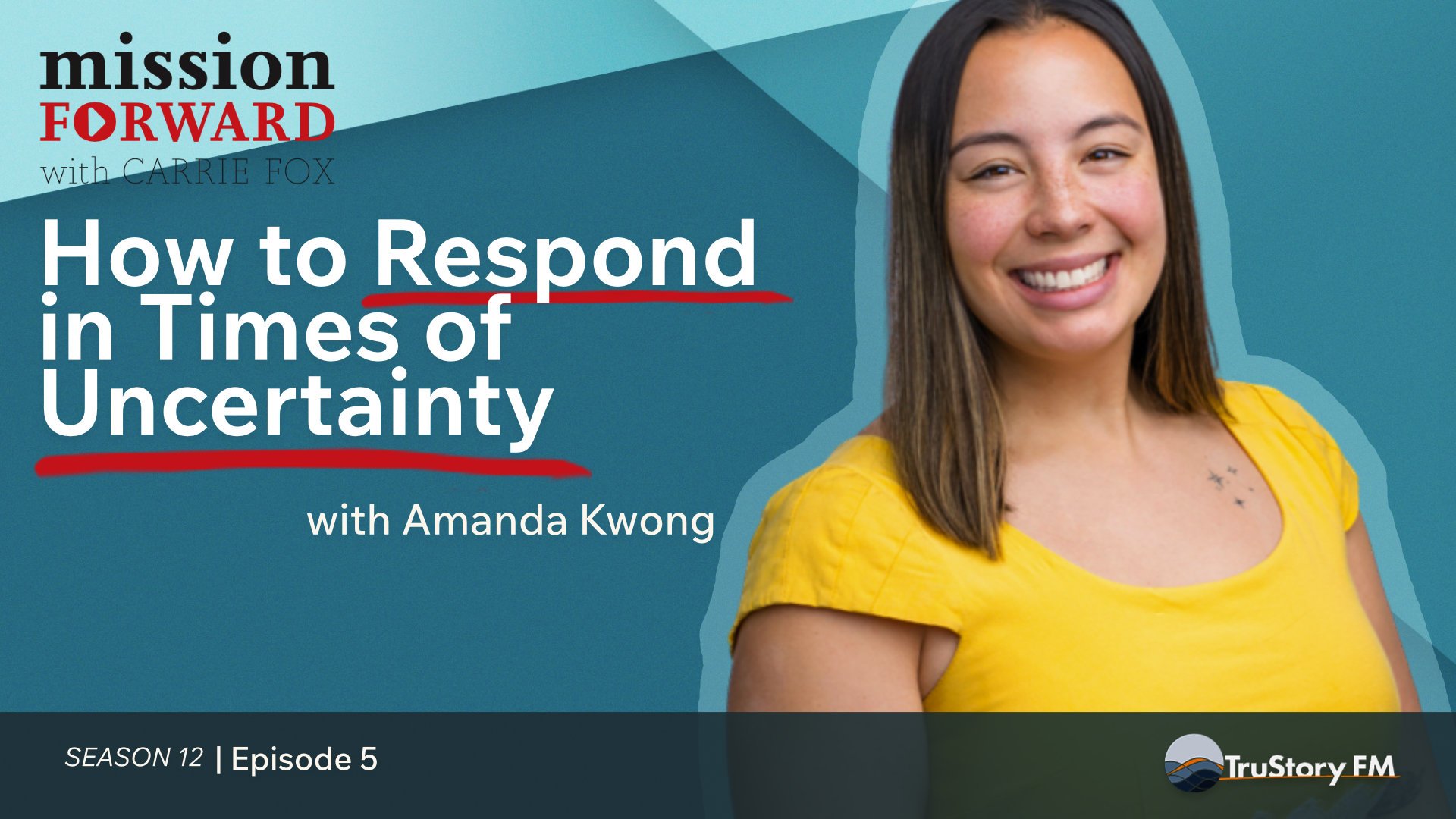
How to Respond in Times of Uncertainty with Amanda Kwong
About This Episode
There's a version of this conversation that could feel heavy — a public health communications director navigating a moment when national guidance has gone quiet, trust in federal institutions is eroding, and the very words her organization was built around have become politically radioactive. That version exists. But it's not the one Amanda Kwong, from the Public Health Communications Collaborative (PHCC), shows up to tell this week.
In this conversation, Amanda shares the philosophy that powers PHCC, the initiative Amanda directs, which has grown to a community of 40,000 health communicators across the country. Together, Carrie and Amanda examine why the communicators doing the most important work right now aren't the ones broadcasting the loudest. In fact, they are the ones listening the most carefully.
This episode provides a framework to evaluate whether the language you're using is still doing what you think it's doing. Words shift. Culture moves. A phrase that once built credibility can quietly become a barrier, and the communicators who don't notice are the ones who lose their audience without ever knowing why.
As Amanda reminds us, the organizations that will come out of this moment with their credibility intact are the ones that kept asking the harder questions. They didn’t continue asking “what do we say?” but instead asked, “What does this actually mean to the person we're trying to reach?”
-
Carrie Fox
Hi and welcome to Mission Forward. I'm Carrie Fox. And for more than 25 years, I have worked alongside nonprofit and foundation leaders who do the essential work of holding communities together, often in moments of deep uncertainty. And they, like you, are being the leaders we need. But what happens when the moment needs more than we might have? Well, that's why this season we are going behind the scenes of our brand new 2026 Insights on Purpose report. It's research that takes the pulse of hundreds of nonprofit and foundation executives nationwide and asks a simple but profound question. How ready do you feel for what's ahead? And what we found is striking, really. Leaders are under historic pressure, and yet many still feel confident about the future. That tension between concern and confidence and how to lead through that storm, well, that's the space we're exploring all season long. Today, we are talking with one of the leaders who is in many ways at the eye of the storm and serving as the calm in that storm too. Amanda Kwong is the director of the Public Health Communications Collaborative, PHCC for short, at the de Beaumont Foundation. As PHCC's director, Amanda oversees the development of tools and resources for local public health communicators all over the country, ensuring that everyone has what they need to make informed decisions about their health. There's so much of this uncertainty, and she's doing it exceptionally well. I am thrilled for the opportunity to have her here today for a conversation on what we're calling communicating through the storm. Amanda, welcome to the show.
Amanda Kwong
Oh, thank you so much, Carrie. It's so great to be here. Very, very excited.
Carrie Fox
Good, good.
Amanda Kwong
Yeah.
Carrie Fox
I'm thrilled to have you. So Amanda, we got a lot that I want to cover today, and I might have you actually take us back to the beginning first. I know a lot about PHCC, but our listeners might not. So give us a little bit of that founding story, why PHCC exists, and then you know from there take us to the present day.
Amanda Kwong
Sure, yeah, sounds good. So the Public Health Communications Collaborative has been around for over five and a half years. We started in August 2020 out of a real need for a convening hub that kind of sat neutral outside of the government but was following CDC direction around COVID safety. There was a desire for state and local health department communicators to turn to a place that had plain language, evidence-based communications around those initial COVID messages. So if you kind of think back to those days, social distancing, masking, staying safe, those were all messages that health departments needed in such an urgent time. And they needed it quickly. PHCC got its start by the union of the major leaders in public health philanthropy and public health communications. de Beaumont Foundation was there. They are a foundation that supports governmental public health projects related to policy, partnerships, and communications. We had the CDC Foundation, they're the nonprofit arm of the CDC, and then we had TFAH, Trust for America's Health. They were the third partner. They're focused in on policy and engagement. And the three of them came together and formed this collaborative. It came to be pretty quickly. I wasn't here during the initial founding, but they built a website in just under two weeks in partnership with your team actually. So Mission Partners has been the communications agency of record since the very beginnings of PHCC. So we already, the team saw immediately that there was initial uptake and interest around PHCC outside of these groups. Folks like in NACCHO and ASTHO and all of these different public health membership organizations, just a desire for I need a social graphic that's going to communicate the benefits of masking. But I'm working in a comms department that only has maybe one person or two people that might have the skills, might not have the skills. So that was another reason why PHCC was founded, out of a need to support the workforce in ready-to-go messaging, but also acknowledging the realities of working in a health department at that time. Communications has not always been the priority in health departments. It's sometimes seen as the last thing to include as part of your strategy. But as a communicator, I think they should be in the room at the very beginning. Good communication drives so much of the success of a business, of an organization. So from just doing research, we learned that there's such a need to have PHCC in a public health communicator's back pocket, because they might be the only person doing communications for their entire health department or they're doing communications plus something else. But with PHCC, we can kind of serve as that companion in helping them do the work. So how can we help them in the day-to-day in kind of scaling their messaging without having to spend hours in producing it? But also community space too. For some parts of the country there's folks serving in rural health departments and the closest health communicator can be miles away. And so how do we create a hub for concise, plain language information and also create a community of people that can kind of come together and share like, what are you seeing? What are you learning? So they don't feel entirely alone in this pursuit.
Carrie Fox
What I love about PHCC is you know a good idea by how fast it takes off, right? And PHCC took off. So from that early sense of oh my gosh, there's a gap here, we can show up and support public health officials in making sense of how to communicate through a crisis, you saw pretty quickly growth from a few people to a few hundred people to a few thousand people to tens of thousands of people who are engaged in this community now, right?
Amanda Kwong
Yeah, yeah. And we're at 40,000 people now with our newsletter. So folks that are downloading our resources, joining our webinars, taking our trainings. And I think a lot of that also has to do with PHCC expanding our offerings beyond just COVID messaging. So we got our start being that hub of information for COVID, but now we provide messaging and resources for 35 different health topics, both urgent and kind of evergreen topics like flu. We know that flu season will always be circulating around and so having the latest messaging there is so helpful.
Carrie Fox
Yeah. I look forward to the day when there is not a public health emergency. There appears to always be one. And when there is one, I'm glad you all are there because you really do help to make sense of some difficult topics. Let's talk about the language because that's why you all exist. Right, you came to be because the language was hard to understand, the guidance was hard to make sense of, and so you put this really wonderful plain language lens through to public health communication. And you've had to navigate some difficult moments on how to communicate in moments of crisis. What have you learned when you think about what it really takes to communicate clearly through a crisis?
Amanda Kwong
Mm, definitely. I think back to where I was in 2020. So I wasn't the director of PHCC at the time, but I was working at the Ad Council. And I really saw the power of plain language being so much at the forefront. And so just background, in 2020, the Ad Council began working on what would be the largest public education effort in US history, with over 300 major brands, media companies, and community-based organizations called the COVID-19 Vaccine Education Initiative. It's called It's Up to You. So recognizing that there was such a need for a large-scale campaign, both from a media perspective and grassroots perspective, that acknowledged that people have a lot of questions about this COVID vaccine, which is totally fair. We saw in research at the end of 2020 when we were kind of gearing up to produce this campaign that there was a lot of skepticism given the speed of how fast the vaccine was being produced, how quickly people needed to mobilize and make the decision for themselves. But we wanted to really hold people in that space and say it's okay to have questions. Like we are here to kind of help you get the facts and get the information so you can make an informed decision for yourself and for your family. So so much of that message refinement in those early days of COVID education vaccine work was focused on plain language. There, it felt like there was just so much jargon around the vaccine process. And trying to, you know, look at anything we put on our website through the lens of writing messaging between fifth to eighth grade reading levels as a standard for plain language was really effective. When I was working on the COVID-19 Vaccine Education Campaign, my focus there was being the creative lead for producing TV and radio PSAs for distinct audiences. So including the Black and African American community and the Asian American and Pacific Islander community. And what felt really powerful in doing that kind of communications work was the power of local voices. I think that this still feels very familiar in how we're seeing public health comms develop, is thinking like the most effective messenger isn't a national official on TV. It can be your local doctor. It can be a community leader. It can even be a pharmacist. So what feels most familiar when I'm reflecting back to leading creative work for the COVID campaign at the Ad Council in 2020, this still feels really true to what we're doing now, is the focus on the power of local voices. And a couple of other things that are feeling really familiar is information overload. The infodemic is still very much here. There's so many places where people are gathering their information, both online, offline, and people are overwhelmed by the sheer volume of health advice. This especially is complicated with the rise in AI, making it difficult to distinguish between high-quality evidence and well-packaged misinformation.
Carrie Fox
Can we just talk about that for a second? Because I am so glad you said that. I was teaching a class last week at a university, upper-level grad students, so juniors and seniors who were really struggling with how do I know what's real and what's not, right? So as I'm trying to make sense of what my government is saying to me, my local government and a university official, how do I know it's real? How have you navigated that? I mean, that is a really tough thing to exist through, the age or the rise of AI when you are trying to earn and keep the trust of local residents around public health issues.
Amanda Kwong
Yeah, there's just so much, there's such a swirl of information that is out there and there's a lot of inaccurate information that's coming from the highest levels of government. And so when supporting the public health comms workforce, it's having them kind of feel equipped to develop their own perspective and point of view on what is accurate information. Because this is getting a little bit in the weeds around how public health works at the governmental level, but there's been this shift away from national guidance around health messages. So when I was working at the Ad Council, I was in direct contact with my CDC comms leads over there every day on like what are you hearing? What is the data? And then how can my team kind of distill it down into plain language and push it as a new FAQ on our website? Being in direct communication with CDC, that was so much of my reality in 2020. They almost were on more of a speed dial than my own mom. But when we don't have that national guidance like we do right now, it presents a challenge, but also a way to kind of get creative. And so one way that we've been helping our public health workforce kind of think about navigating through that is uplifting local news and local information. I think if they're reaching their audiences on social and they want to demystify the misinformation that might be swirling in their communities, turning to local voices. Because at the national level, there is this loss of trust that we're seeing. And so the focus on going more local in your language and in your approach is something that we're leaning into for PHCC.
Carrie Fox
Nice. And that's a good message for anyone listening on how do I communicate in a way that will help make it make sense, right? That will help to earn and build trust of community is look local, that you've got people who are, regardless of what your issue or organization is, that you've got people in your community who can help make sense and be those authentic and real voices to make those issues make sense. So let's talk about if there's maybe an example of a resource that you've put out in this past year, right, that gives folks who are listening a sense of how you make a really complicated topic more easily accessible or understandable. So how it becomes practical in your world.
Amanda Kwong
Earlier last year, we got connected with the Planetary Health Alliance, which was a group based out of Johns Hopkins University. They're focused on planetary health. And when I first met them and got connected, my mind was going to, oh, like the planets, like Mars, Venus, Jupiter. But I very quickly learned that planetary health is more of the relationship that our own individual and community health has to the environment. And so recognizing that when the environmental health is showing signs of decline, our own personal health is also going down as well. So there's this really strong relationship, an opportunity to kind of increase awareness and understanding of how our environmental health is connected to our own. But the fun opportunity with this partnership is that planetary health as a working definition, awareness is quite low. Like I didn't even know what planetary health was, but there was such an opportunity to explore this partnership, explore this resource with a totally new partner that we might not have partnered with in the past. That's the beauty of PHCC is we kind of service this tent that has folks from all different corners of public health, but also the tertiary sides of public health, thinking about business, thinking about the environment, thinking about mental health. There's always an opportunity to think of ways that public health can connect to these topics and writing it in plain language. So what we did with the Planetary Health Alliance was create a multi-page guide that is so much the heart of PHCC. We don't want it to be a 20-page deck. We recognize people are super busy. They don't have a ton of time, especially in this moment. They're being pulled in different directions. So how can we kind of distill down what planetary health means in plain language and then kind of identify the connection points to be made across planetary health and public health? It turned out to be one of our most successful guides of last year. High downloads, high engagement, people saying I didn't even know what planetary health was. But this is a really interesting way to approach the climate change conversation. So we're thinking about words and words that are more charged. If we were to put this kind of communications under a climate change umbrella, then it might drive a different response. But if we're thinking about how do we advocate for the environment and supporting healthy communities in that, are there other words or language we can be using here? And so I kind of see this shift that we have made in the field towards building awareness of planetary health as part of supporting your environment. Like there could be a really interesting opportunity there, maybe for lobbyists or for decision makers to see it differently.
Carrie Fox
So that is really interesting on a couple levels because when you first heard it you said, I don't know what this means, right? You know, it conjured up something else. But in learning about it, you realized, hey, this is a way to frame that actually is less charged. It's more, it opens a different door to be talking about climate in a way that's more expansive for audiences. And so just simply in doing that, you were able to talk about something and build engagement in a way that maybe your audiences would have turned it off otherwise. Right, if you had gone with older frames of how to talk about climate change, for instance. I like that expansiveness, like really thinking wider about how we communicate does a couple things. It brings more people into the conversation. It lets more people see that it matters to them. It lets more people feel connected to the work. And I know that's a big part of what you all do is thinking about how are we both simplifying language to bring people in, but expanding the universe so more people see their connection to the work. And while I know that the Public Health Communications Collaborative exists for public health leaders, I'm going to advise that anyone listening, if you are the lead of a large organization, whether that's a foundation, a nonprofit, a university, there are very likely resources on PHCC that you can benefit from because I think that there is overlap to many, many other sectors. So Amanda, here's a plug, and I'm going to put it in the show notes too, but the website, share the website quickly for me.
Amanda Kwong
Sure, https://publichealthcollaborative.org.
Carrie Fox
https://publichealthcollaborative.org. So what will you find there?
Amanda Kwong
Yeah, you're going to find several different ways that you can strengthen your communication skills in the short term, but also the immediate term. So if you go to our topics page, you can see science-based, plain language messaging across a slew of different topics. So if you're looking to pull together the latest talking points on measles for your community, know that the information shared there is evidence-based and has been worked through a couple of different folks on our team to make sure that it's accurate and you can use that for internal and external communications. For long-term skill development, we have our communications tools. So those are not topic-specific. They're more of like, I think of them as the lever that you pull on whenever you're developing messaging. So our plain language guide is one that you're absolutely right is cross-cutting. It's not just for public health, it's for anyone that is focusing on community communications impact. I think of our resource Communicating with Heart. That is one of my favorite resources. I'm so excited that we'll be building, we're going to be building more programming based off of that one resource. So more to come. But that resource is all about empathetic communications and how can we be more compassionate when we are working with people that might see things differently than us. Thinking about the value of active listening, thinking about not forming an answer before someone has finished their sentence. These are things that can apply to so many areas beyond just public health. And then the last pieces I'll mention, we have what's called our alerts page. So this is a page that is powered by social listening with our partners to understand what are those key public health topics that are popping up that are high, medium, low impact. So thinking about what are the big conversations that are happening right now. And what can you do as a communicator to support more accurate information around the possible misinformation that might be happening? So we have our alerts and then we have our PHCC Academy. So that is our dedicated online training program. The trainings are no more than two hours, but we have a course on strategic communications, crisis comms, community engagement. We see folks from public health taking those courses, but also educators, social activists, really anyone that has a role in communications. And then our webinars too. Our webinars are really awesome.
Carrie Fox
I mean, it's incredible.
Amanda Kwong
You'll find the recordings.
Carrie Fox
It's like such a rich network. So yeah, and I do think there's really a little something for everyone there. The other thing that I want to name is, you know, I've heard many times in this past year organizational leaders who have said, my issue is so political, I don't know how to communicate it because it's so political. And what I really appreciate about what you've done and offer as a case study is that you don't take any of this through a political lens. You take it through a public service lens. Right, you are thinking about how do we communicate in a way that communicates with our widest audiences so that people can make informed decisions about their health. There's nothing political in that. It's just how do we provide fact-based, accurate information that lets people make healthy decisions or decisions about their health, I should say. And I think that's really important because there was some research, now this is from October 2025, but it was an Axios survey, it was called the American Health Index poll, where they found Americans' trust in federal health agencies like CDC is declining and more than twice as many people think the administration's policies have made the country less healthy. Now, you could believe anything you want. The fact of the matter still is people need good information to make choices. And you all provide that. You fill that gap. Have you found any instances through this process of the last year where you had to really think about, gosh, how do I communicate this so it doesn't feel political, right? Like you've had to dance through some delicate pathways here to make sure that it's not political in your message.
Amanda Kwong
Yeah, so a bit of some story time here. I travel a lot for this job. I've been able to go to so many parts of the country that I've never been to before. I've hopped in many an Uber ride and I've just kind of described my day-to-day and what I do. And so it's kind of a fun side project in just increasing awareness of public health. But one of the times that I was traveling for work, I had a keynote on the next morning for a state public health association. And I wanted to provide some leave-behind materials for those that were in attendance. We have a slew of different resources for PHCC. The ones that are most popular, we create these little mini, I pulled this just so I can see, these little mini guides. And they serve as just really helpful, like when someone attends one of our keynotes or trainings, they can take it with them. It's already printed out. They can have it by their desk and they can flip through. So the power of print is cool here. But I brought some copies with me. I had them in my bag. I was going through security at the airport. And my bag was flagged. And I was like, oh, maybe I left something in there, maybe an extra bottle of water, we'll see. The bag was pulled. And they said, do we have permission to go into your bag? And I was like, sure. So they went into the bag and the reason why my bag was flagged is because through the X-ray scan, they were able to see the cover of this booklet. So the cover says the Public Health Communicator's Guide to Misinformation. And this is a printout of our misinformation guide. And I was like, okay. They said, what do you mean here by misinformation? And kind of just questioning me about the intent of this guide, if it was propaganda. And I very quickly realized that the reason they flagged this resource in my bag was because of the word misinformation. And so to avoid holding up people behind me in security, I ended up getting interrogated for a good half hour and almost missed my flight. And this was something that really shook me because I wasn't expecting to get pulled over by security. I was just trying to do my job in being a public health communicator and share with people here's some tactics and strategies for navigating misinformation in your community. And it really shook me or shocked me because this word misinformation is so charged. I don't know if the TSA team had a list of words that they had to screen for. I'll never know. But I really took this experience as a lesson in the power of words and how triggering they can be, how polarized they can be. And so coming out of that experience, I held a strategy session with my managing partners for the collaborative, including the folks from Mission Partners, our comms agency, and Mission Partners led us through a really wonderful strategy session on just assessing throughout 2025, what were those words that were causing alarm? And what are some recommended alternatives that we can be saying instead? So misinformation a few years ago wasn't a very charged word, but it carries a lot of weight to it. So through the strategy session, we ended on some alternative language we'd be using instead. So instead of saying misinformation, all of the instances of that across our website, our webinars, any kind of piece of content is now written as false claims or misleading information. So it was just really helpful to get in a room with the advisors of my group and my comms agency to kind of just pick at those things that have been hanging over our heads and coming in with a really strong point of view on where PHCC stands. It's been really cool seeing how PHCC has become such a leader in the public health comms space. We were just reviewing our evaluation results with our evaluation partner a few days ago. And through focus groups we heard that, and this was something I didn't even know before, that people turned to PHCC as a gut check of excellence for communications. Which is really cool. I didn't know people were doing that. Like I knew people were downloading our resources. They were using our social graphics and pushing them onto their social media accounts. But seeing that we have become one of those credible sources for people is really satisfying. And I think a lot of that has to do with the partnership between our comms agency, our managing partners, and just advocating for being really clear on these are the words that are just coming up as pain points and how can we think of alternatives so that we're not putting ourselves in a position of partisanship or anything sticky.
Carrie Fox
Right. Right.
Amanda Kwong
Yeah.
Carrie Fox
There's so much about that story that I appreciate you sharing. And I'm not even sure where I want to go first because I want to go so many places, but I'm gonna start by thinking about how nothing about language is static. Right, if we think about the ways that, I think even myself, the way I communicate versus the way my 16-year-old communicates, there are different words that we use and those words hold different meaning. There are words that we used in 2020 to try to convey a certain emotion or feeling or approach, and those words don't necessarily work today. And I think what's important about what you all have done, and I wish you did not have to go through that experience, so we start there, and what that reminded us is that there are different ways. It goes back to that expansive. Right, there are different ways to communicate to get the same point across, sometimes even better. And you all have such a pulse on what language is working. You do the research around what language is working. You listen so, so deeply. You never make assumptions about what's gonna work better here or there. You listen. And that's something that again I want the listeners to take away, that I think we find ourselves, we get in the most trouble when we make assumptions about what language means, what language is gonna work, what language isn't gonna work. But you all have really done an exceptional job of listening, taking stock in how people are reacting to language, and then adjusting accordingly. And I think it really has contributed to that high, high level of trust that you all have, right? You are consistently trusted as a resource and it's because you take it so seriously.
Amanda Kwong
Yeah, especially in the absence of those national leaders in the public health comms space looking differently now. Another example of careful wording and why it matters is this statement around anything vaccine communications related, around how vaccines are safe and effective. That is, I remember sitting in the focus groups at the Ad Council for our vaccine campaign and seeing that as the number one message that popped, that people were like, all right, this is the messaging. We're going to lean into that. And then I saw the ripple effect. All the other, you know, from public health nonprofits to health departments using safe and effective. That messaging just does not work anymore. It takes away the autonomy and the choice that people have around vaccines. And vaccines are so deeply personal. Not trying to get into the vaccine conversation, but if I could give you a percentage of how much of my job is spent on vaccine communication, it could almost be its own full-time job. So instead of saying safe and effective when communicating about vaccines, we in the workshop reframed to say how vaccines are developed to keep you healthy. So it's the idea of instead of focusing on the attributes of the vaccine itself being safe and effective, it's considering more of the person-first approach that paints a more positive, healthier picture of outcomes and what could come from that. So something about the person-first approach language was really effective here and it's been cool to kind of see the industry adopt that same kind of messaging that PHCC has set. So it feels, it's a high pressure situation, but I feel like there's never been a time in this job where I didn't feel supported. I have an amazing group of advisors and team and vendors that are just so committed to this mission and it feels awesome. So yeah, I just wanted to lift up another example.
Carrie Fox
Hmm. Well, that was such a good example.
Amanda Kwong
Yeah.
Carrie Fox
All right. We're a little over time, but I couldn't help it.
Amanda Kwong
Okay.
Carrie Fox
It was just too good. So here's your last question. I would love, you've spent the last half hour here or so telling us a lot about what you're responding to, how you're responding so effectively, and it's a lot because there's a lot happening outside your control that you are in fact needing to respond to. But there's good, right? There's good in the world. And so I wonder if there is something that is giving you hope or that gets you out of bed in the morning and says, I am contributing to this. What is it that leaves you feeling hopeful about where we are and where we're going?
Amanda Kwong
Hmm, yeah, that's such a good question. I'd say the thing that gets me out of bed and is keeping me hopeful is talking with students, talking with students that are getting their masters in public health, that are getting their bachelor's, and just seeing how they recognize coming into this workforce is going to look very different. There are less jobs, less opportunities, but that passion to drive real change and impact in public health I so strongly feel. I feel like students are such a beacon of light and joy. And I think they have, the generation below me just has so many fun ideas on how to think about communications differently. So there's been this movement towards trusted messengers and working with influencers for health. But what does that look like for health and wellness? But what does that look like for public health? I'm just really excited to just see a new generation of public health communicators join this workforce as the job market over time continues to evolve and people are hired because this generation below me is digital first. They're very digital savvy, but they're also really focused on community and people. And I just feel like looking at my social media feeds, the content is just so fun. And I think for public health, it needs to be fun. I feel like this ongoing adventure that the de Beaumont Foundation is on, where how do we increase the awareness of public health? How do we bolster public health literacy so that ultimately everyone in this country knows what public health is, that it's different than healthcare, that public health is what is there to help you get to work safely with sidewalks or preventing from getting more sick with the vaccine? But yeah, I'd say students are the thing that really excites me about this work right now is talking to different students and hearing their ideas on how PHCC could be more digital forward, more savvy. Yeah.
Carrie Fox
Well, Amanda Kwong, at the top I said that you were like the calm in the storm, and you really proved that today. I mean, we could have gone into a conversation about public health that felt heavy and overwhelming and oh my gosh, where do I even begin? Every new day is a crisis. But what you did for us today is remind us that every day provides a possibility of how we center people, how we communicate clearly and plainly, how we move people to make informed decisions about their own health, how we work in service of that mission that you all live and breathe every day. So thank you for doing that. That's what I was just hoping you would do. I'm so thrilled I've had this time with you today.
Amanda Kwong
Of course. Thank you so much, Carrie.
Carrie Fox
And that brings us to the end of this episode of Mission Forward. I am so grateful to Amanda for spending some time with us today. And as she noted, we have been so proud to be part of Public Health Communications Collaborative really since its infancy. It's a big part of what drives us forward every day to be part of the work that she is leading. So thanks for tuning in today and until next time, keep your mission moving forward.
