About This Episode
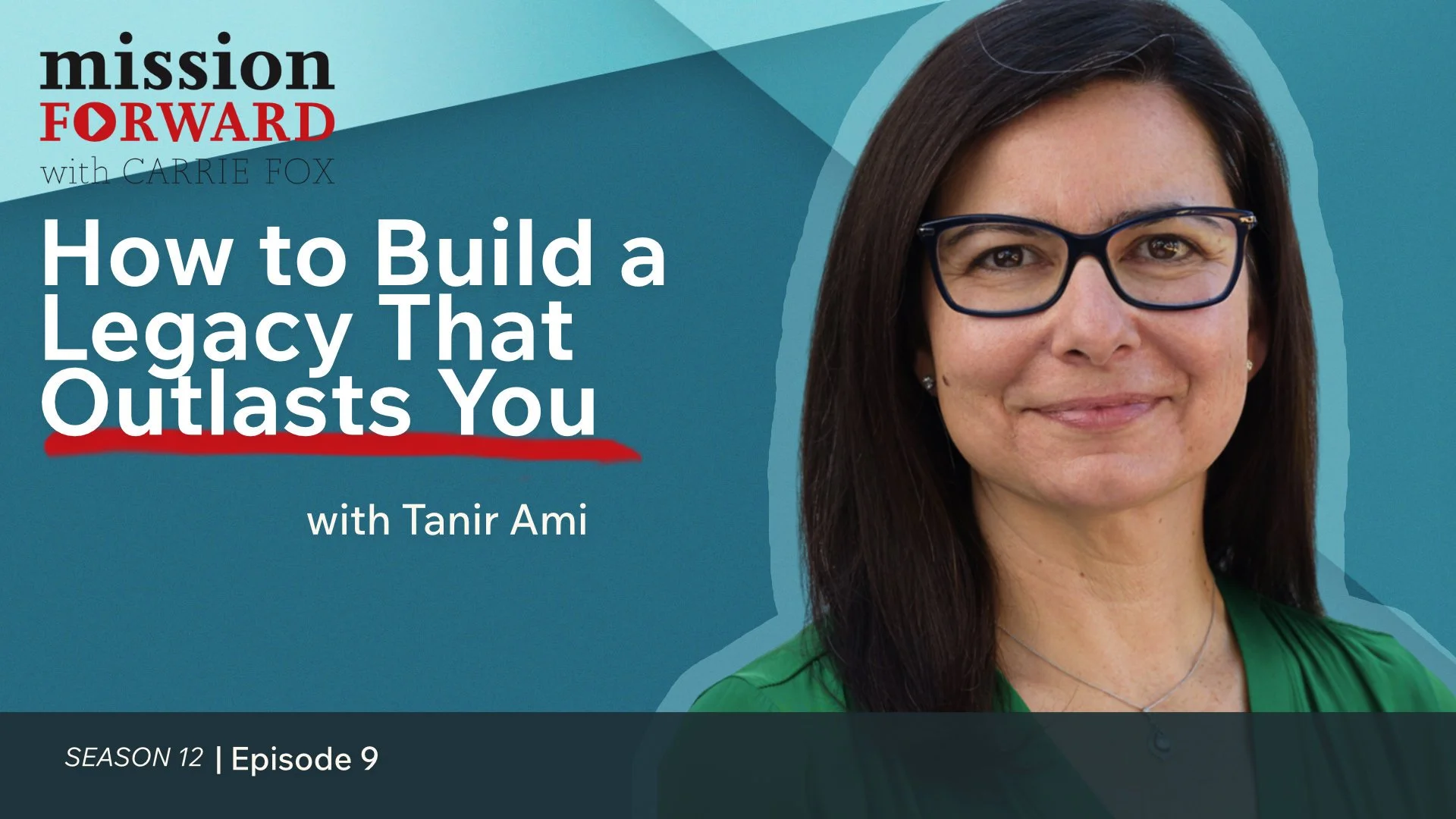
You probably know the dream where you need to run and your legs won't obey. Carrie names that dream halfway through her conversation with Tanir Ami this week, and from there it's hard to let the idea go. What Tanir describes, and what the whole nonprofit and foundation sector seems to be describing right now, is the waking version of it.
In 2020, leadership looked like a million-dollar check hand-walked to a closed UPS office. Decisiveness was the whole job. The uncertainty was acute but legible: a virus, a curve, a set of immediate needs. You moved, or people died. Today's uncertainty is different. Tanir calls it "quieter." The threats are diffuse, the timelines unclear, the systems shifting in ways that might not surface for months or years. The instinct to charge forward survives. The sense of which way to charge does not.
Tanir, in the middle of all this, did the opposite of what the field expected. She narrowed. While other leaders were being told that strategic planning had become too hard to attempt, she and her team spent the year writing one. Not a sprawling, hedge-everything plan. The CARESTAR Foundation's new strategic plan turns on a single sentence: eliminate racial disparities in emergency medical services care across California.
The 2026 Insights on Purpose research that anchors this season found that most leaders are making major changes to grantmaking or fundraising, and most are doing it without a strategic plan at all. The reasoning is easy to follow: when the ground keeps moving, why commit to a destination? Tanir's answer runs the other way. When the ground keeps moving, the destination is the only stable thing on the horizon. The path will change. The collaborators will undoubtedly change. The question of what you are trying to alter about the world only gets sharper under increasing pressure.
When Tanir shared this new, tighter focus publicly, nobody backed away. They moved toward her. Committing publicly to one specific thing made her easier to find, and the plan turned into an invitation.
In this week’s Research Brief, Matt Price points the same direction: health-focused nonprofits report the lowest optimism of any subsector in the study, and they are the ones who most need a funder willing to cover work that is, as he puts it, "sometimes under attack."
Carrie's dream, the one where you run and stay in place, marks one texture of leadership in 2026. This conversation points to another. Choose one thing, say it out loud, and build the plan around it. The legs start moving again. The dream hasn't ended. You've just stopped trying to outrun it.
-
Carrie Fox:
Hi, and welcome to Mission Forward. I'm Carrie Fox. For more than 25 years, I have worked alongside nonprofit and foundation leaders who do the essential work of holding communities together, often in moments of deep uncertainty. And they, like you, are being the leaders we need. But what happens when the moment needs more than we might have?
Well, that's why this season we are going behind the scenes of our brand new 2026 Insights on Purpose report. It's research that takes the pulse of hundreds of nonprofit and foundation executives nationwide and asks a simple but profound question: how ready do you feel for what's ahead? What we found in that research was striking. Leaders are under historic pressure, and yet many still feel very confident about the future. And that tension — that tension between concern and confidence, and how to lead through that feeling — well, that's the space we are exploring all season long.
And today we are talking with one of the leaders who is modeling how to lead through change so effectively. Tanir Ami is the CEO of the CARESTAR Foundation, a California-based foundation that is helping to reimagine emergency and pre-hospital care in California in service of racial justice. In fact, their recently released strategic plan makes their purpose crystal clear: to eliminate racial disparities in emergency medical services care across California.
Now, over the past year, Tanir has led her board through an intensive and very intentional strategic planning process that explored many of the questions that feel close to home for many of you these days. What does our community need from us right now? What kind of impact do we want to have? And what will it take to look back years from now and say without a doubt that we changed something meaningful? Today we're going to learn more about how she navigated that process with her team, how she held both the need for clarity in a time of uncertainty, and how this new strategy is a perfect example of an organization living through its values. Tanir, welcome to Mission Forward.
Tanir Ami:
Thank you so much for having me, Carrie.
Carrie Fox:
So give us a little more grounding. Tell us a bit more about the CARESTAR Foundation — maybe why it came to be and what your focus is today.
Tanir Ami:
Absolutely. So the CARESTAR Foundation was funded by the sale of an air ambulance company in the state of California called CALSTAR. CALSTAR existed for well over 30 years. It was a small nonprofit organization run by a consortia of Bay Area hospitals. They got together and decided that it would make a lot of sense for them to have their own air ambulance service company that they shared. And they did that really nicely and well together for, again, 30, 35 years.
And back in 2017, after many discussions, they decided that it was time to sell the company. It was no longer financially viable the way that it had been in earlier years, and they felt like someone else could do just as good a job running it with the care that they put into it. And so they sold it to a for-profit company called Reach, also known as AMR or GMR, depending on how you know them. And the proceeds of that sale — $65 million that they paid for the fleet of ambulances and the name and the staff — became what is now in our bank account and what we were told to do when we first founded the organization, which was honor the legacy of the CALSTAR organization. CALSTAR provided really exceptional services in the pre-hospital care arena. And so that's where we focused, and we tightened our lens on the work and the amazing services that are provided in EMS and pre-hospital care. And that's what we've continued to do.
Carrie Fox:
So in full disclosure, I've had the great opportunity to work with you and your organization. And what I found so enlightening in getting into this work is some of the data that sheds light on the situation that you seek to address. I'm curious if you can paint a little more of the picture of why racial justice, why racial disparities — why that work is so critical to your mission.
Tanir Ami:
Yeah, it's a great question, and one that is not fully integrated yet in the field of EMS and pre-hospital care. There are so many people working on improving clinical quality in the pre-hospital care sphere. And racial equity was something that we wanted to also elevate and draw attention to. As we know better in other fields — particularly primary care, where I've also had a lot of experience, and in hospital care — when we dig into disaggregated data, we do see differences in treatment and outcomes for different racial and ethnic groups and populations. And so we wanted to bring that lens also to the pre-hospital care arena, where some of those conversations are definitely happening and also still in their infancy.
Carrie Fox:
The work that you work on is mission critical. It is life-saving, it's transformational — all of that critical work as we think about people who are in public health and advancing missions like yours. I'm curious how leading this work today feels in comparison to what it felt like in 2020.
Tanir Ami:
It's a really, really great question — one that I hadn't really reflected on, even though I could have sort of emotionally responded to it. It really gave me an opportunity to reflect. I think there are some big differences.
I think in 2020, with the onset of COVID, my recollection of that — the energy and sort of what was happening there, particularly from a leadership perspective — is that we were so quick and bold in our responses at that time. The way I would sort of name the difference between 2020 and today is that that time felt like the sense of urgency was just so intense. And the decisiveness that emerged from that moment was also just — things just felt swift. We moved. We really stepped up to that moment in a very intentional way.
When COVID hit, we had a clarity of purpose. The need was so immediate. It was so undeniable. And I think that all gave us permission to just act boldly. I have such a clear memory of moving a million dollars in one afternoon and hand-walking this check to UPS even though it was shut down and saying, "I need to get this million dollars to the statewide emergency medical services authority to move something really swiftly." We knew. We did not hesitate to act. There was uncertainty, of course — everyone remembers the uncertainty, we didn't know what we didn't know about the disease and how we were going to make longer-term decisions — but it still felt like collectively everyone was willing to move and take risks in service of responding to that moment.
And today things feel a little different. The uncertainty is definitely still present, but it feels more diffuse, and in some ways a little bit more — I hate to use the word "paralyzing" because we're not standing still by any stretch of the imagination. We're navigating economic instability, questions about healthcare access and who will continue to have it, policy shifts that are coming but we don't really know how to predict their impact yet. So what I feel today is a little bit more caution. Instead of acting really quickly and swiftly, I feel like there's more scenario planning, there's a little more hesitation, there's a little bit more wait and see. Just a flavor of, let's check this out, we really don't know necessarily how to step up and what we're really being called to do in some ways. So it's changed the pace and the posture.
To kind of sum it up, it feels more like a quieter uncertainty where systems are shifting in a way that may be less visible to us, and we're trying to really find that balance between taking risks but behaving responsibly for what is still uncertain in the coming months and years. I think it's kind of testing us — testing our patience and our ability to take risks, our courage and our judgment. That's sort of how I would characterize the difference.
Carrie Fox:
That was such a visual answer, Tanir. As you were speaking, all I could think was back to those dreams — or maybe nightmares — that I know I've had over the years where I'm trying to run and I can't get anywhere. This idea that the urgency is just as great, and yet there's something that has us stuck a little bit more. Being careful and cautious in how you're making those decisions — that's sticking with me, that visual.
Let's hang on that for a minute, because I mentioned at the top that the research we had done showed this really interesting duality: that leaders are saying this is historic pressure we're under, and yet we still feel confident in our ability to move this mission forward. Would you say that's the way you feel? That you still feel confident in your ability to move it forward — it's just almost how you get from point A to point B that is the question right now?
Tanir Ami:
Yes — your listeners can't see me, but I'm nodding my head very vigorously in response to that question. That sounds really understandable. It was very resonant. Yes. There's that tension between pressure and optimism, and that's how I'm experiencing this moment for sure.
On the one hand, I have deep concerns about what's happening at the national level and how that will trickle down into our communities, into states and local populations. The implications of HR 1 and the loss of healthcare access really terrify me — what it will do to safety net systems, which is of course where we operate, and how safety net systems are always asked to step up in times when people lose more stable structures. So any week you feel the weight of that in conversations across the field. We don't know what's coming, but we don't think it's going to be good.
And then at the same time, I'm out in these meetings and I'm feeling really hopeful, because I see progress being made. Our statewide organization is launching an equity framework that we were a huge part of, and we never would have seen that before. It's amazing work that's going to happen. That's an example of some groundwork that I'm seeing get put into place — just many, many ideas that are taking shape and communities that are building to really respond to this moment makes me feel deeply, deeply hopeful.
So I do think we're going to see more equity-based conversations. I do think we're going to see more conversations about how we can support special populations in navigating this moment. It's both. Being a leader now means holding both of those things: deep concern — my brow is furrowed about this broader context we're operating in — but also just watching so many people and communities really get creative and smart and dig in to try to create some change, some longer-lasting systems change in that context. It's really hopeful.
Carrie Fox:
Creative — I'm so glad you said that word, because it's been a really important theme of the other interviews I've had with both foundation and nonprofit leaders. There's this theme that the moment we're in requires us to reimagine. And sometimes reimagining can feel scary, and sometimes it can feel exciting — to say the way we've always done this may not be the way we're going to do it moving forward. We've heard from several other folks on the show who have talked about very interesting collaborations between foundations and nonprofits that wouldn't have existed outside of the time that we're in. So I'm curious if anything comes to mind — anything you're seeing that speaks to that kind of creative collaboration and problem-solving inside your world right now.
Tanir Ami:
Yeah, I do see that. I do feel like there's more energy to have convenings, discussions — people really want to come together. I think they want to ideate and to be in community with one another. I'm watching just so many more requests come in for collaborations and convenings to occur. And it's another way I feel really optimistic and hopeful that more of that will happen, and that people being in community in and of itself is really meaningful at this time.
Carrie Fox:
There are many nonprofits who are saying we want to be closer in community to our foundation. And it sounds like you're already doing that. We know this about the CARESTAR Foundation — that you are in fact showing up in service of and with your community. It's a core part of how you all operate. Curious if there's anything you think about in terms of how you do that, because you model it so well — anything that might be interesting insights for other foundations thinking about how do I get closer to my community, how do I listen better to my community in this time?
Tanir Ami:
I think this is something that we're constantly struggling with and seek to do better. We're a really, really small team, so our ability to do that is limited. The way we're leaning in and showing up to that need to be in close connection with community is: we don't have a large number of grantees, and we are in deep relationship with those with whom we are. In some ways it's a smaller-scale, deep-relationship type of approach.
I know there are so many foundations doing really, really innovative work around polling and listening sessions, and we have done some of that and will continue to do some of that. We produce reports on a regular basis. We survey our grantees on an annual basis. But I think a lot of it is just being constantly in community, listening, and iterating together with our grantee communities.
Carrie Fox:
All right, I mentioned at the top that you all have just recently completed a strategic plan, and by the time this comes out, that strategic plan will actually be live and public in the world. So let's pause here — because again, I'll make another connection back to the research and then I'll turn it back to you.
I found it so interesting that most people we interviewed said they are making major changes to their grantmaking strategy — that's on the foundation side — or their fundraising strategy on the nonprofit side. The vast majority of people are making major strategic changes to how they operate, and a significant amount of them are operating without a strategic plan, because strategic planning feels too hard in this moment. For someone who has just gone through it, I'm curious if you can talk a little bit about what that process did for you all — for you and your board and your staff.
Tanir Ami:
I can appreciate all the aspects of what you're saying. For us, I would say long-term planning has definitely felt harder. And you remember conversations we had several times, right, about is it three years or is it five years? What can we really say? And going back and forth on that.
I think for us, what the strategic planning process really brought was a lot more clarity about the focus we wanted to have, knowing that we cannot be all things to all people. We cannot meet the vast needs that are out there. We needed to really understand — okay, so if we could do one thing, what would that one thing be? And how can we name that one thing? And so that narrowing of our focus was incredibly helpful. I think it's been really helpful for the staff and for the board to just understand: we're all going to focus on just this one thing that we want to change about the EMS field. So as the environment is shifting, it is such a bright North Star, and it's already been incredibly helpful.
It just allows us, particularly the staff, to go through the day-to-day barrage of requests and needs that are out there and just remember — okay, we said we were going to change this one thing.
And yet — and I would sort of not necessarily contradict myself but say yes, and — what's so fantastic about our plan is it has really sharpened our focus and narrowed our North Star and clarified where we're heading, but it's not rigid. There is still room for some expansiveness and input into how we achieve the North Star. There's still a lot of space, and even in the short time since the plan — the ink is barely dry on it — I can already see it beginning to take an even greater level of shape. I can see the pathways to get there more clearly.
So it's been great. We got the focus, we got the narrowing, we've got the pathway and the North Star. And yet we still left ourselves some room to play with ideas and opportunities that are coming up from community members who are in conversation with us.
Carrie Fox:
Tanir, I'm really glad that you described it that way. A few weeks ago we had Tonia Wellons, who's the CEO of the Greater Washington Community Foundation, and she became the CEO 30 days before the COVID pandemic began. And then they were obviously in crisis response mode for quite a long time. And one of the first things they decided was, let's create a 10-year plan, because they said we will get out of this, we will navigate through this, and we're going to look beyond it.
And it's what I felt in your work too, right? There's a lot that we can't control, but what I heard and felt from you and your team was, but there are also things that we can. We can stay really focused on the change we want to see in the world. And then recognize that every year that path might change a bit on how we get there because of all that we can't control. But if we've got that focus, we can be really impactful.
Tanir Ami:
I think that's absolutely right. And that is why we sort of went through that — is it three years or five years — conversation, because I think particularly the board members wanted to make it longer in the end. I think the language of our North Star — eliminating racial disparities — is evergreen. There is no point at which eliminating racial disparities in care delivery in the EMS system will ever go away. That's something we can hang our hats on for a long time. But again, it still gives us the space to think about how we want to get there in any given moment. That's what I really appreciate about it.
Carrie Fox:
And you mentioned earlier collaboration — the importance of that creative collaboration — that you can't do that alone. So your strategic plan really creates an invitation to work with you all.
Tanir Ami:
I certainly hope it does. I really, really do hope it does. And it's been interesting — having a handful of conversations so far about our new tighter focus. Some conversations where people no longer see themselves in our plan, but a lot of conversations where we watch people get really excited and inspired and think in different ways about this idea of, wait, now we're talking about reducing disparities in care? Yeah, I've been wanting to have this conversation for a long time. I'm really excited. Here are all the ideas I have about doing that. And so it's been really rewarding, and much more positively received in so many different arenas and places I didn't expect.
Carrie Fox:
That's great. All right, we somehow are already coming to the end. So I have time for one more question, but I'm going to try to sneak in a quick one first. At the top, I introduced some of the questions that you all asked yourselves over the past year, and one of them was: what will it take to look back years from now and say what we did changed something meaningful? And you've been talking about the one thing — we just want to do one thing. My question here is really about you, because I admire you so much. When you, Tanir, look back 10 years from now, what do you hope to be able to say about what you and your team did at the CARESTAR Foundation during this 2026 time?
Tanir Ami:
Gosh, that is a great question. I think the most valuable thing that we have done and can continue to do is not necessarily about the resources that we have and the money that we give away, but the idea that we've created momentum throughout the state and inspired a statewide conversation about how and why we need to look at racial inequities in the EMS system.
Just having that ability — and that's what resources give us; I'm super aware of that — there are so many people who want to jump into this conversation and have better ideas and better knowledge and they're closer to the problem than we are. All of those things are true. But sometimes it does take a statewide organization that sits just outside the center to create that momentum and the spaces to talk about it and the resources — yes, individual projects may be happening, but it's much bigger than individual projects. It's the idea that we could embed a culture within a system that outlives and outlasts all of us, that takes racial equity as a centerpiece and guides all of the decisions that happen within that system.
That, I think, is our ultimate goal. Did we leave the system more attuned to the fact that racial inequity actually does exist in this part of the healthcare field? That's a lot of how I think our most meaningful impact could be.
Carrie Fox:
All right, so then my last official question, Tanir: what's giving you hope as you think about carrying the weight of navigating through uncertainty, but still feeling hopeful and positive that you will be able to advance — and I believe you will advance — that vision for the future?
Tanir Ami:
That's a tough question, Carrie. Sometimes I'm exhausted by trying to get all over the state and meet all of the people who are doing such incredible work in our field. And then every time I get out there and go to a new meeting and shake someone's hand and hear their ideas about what they're up to, I am absolutely re-inspired to continue the work, to be present for people, and to engage in those conversations. Because I am really hopeful. There's a tremendous amount of energy to do the right thing and to do new things and to change the system for the better — to embrace what's good about it, but also to look for how it can be continuously improved. Really being out with people, in relationship, listening to ideas, and supporting ideas that are emerging — that makes me hopeful.
Carrie Fox:
Tanir, my final thought is a thank you. I mentioned at the top that we had this wonderful opportunity to work with you and your board, and we have worked with many boards on strategic plans. I will always say that there was something very, very special about working with you and your team because of the presence that every single staff and board member brought to that process. They were in it. They were deeply in that process with you. And you don't see that in every organization. The investment of care, the ability to be kind of courageous in tough discussions — that doesn't happen without a leader like you. So you wouldn't say that about yourself, but I'm going to say it about you. It was really a wonderful process to watch you lead, and I'm grateful to be able to learn a little more from you today in this setting.
Tanir Ami:
Thank you, Carrie. And I want to just underscore and echo — you're right that no one was phoning it in. We were all deeply invested and totally present and really invested in the outcomes. So thank you for that.
Carrie Fox:
Well, we'll be watching your work. Thanks for joining us today, and we'll continue to cheer you on and support you.
Tanir Ami:
That was my pleasure. Thanks, Carrie.
Carrie Fox:
It is the second of our new segment called Research Briefs, which we are bringing you with our researcher in residence, Matt Price. Matt is the founder of Empath Insights, who helps all of us connect the dots between what we're learning on the show and what the latest research says on those same topics. And today we have a lot to dig into. So, Matt, thanks for coming back.
Matt Price:
Yeah, thanks so much, Carrie. I was able to listen to Tanir's interview, and it was really powerful, really interesting. I especially appreciated how passionate she was about racial health disparities and racial equity in the health field. And I think my first question was really: to what degree are people even aware of issues surrounding racial disparities in healthcare?
It can really vary. We do know that people in the US believe that healthcare is something akin to a right — that you should be able to pursue the highest level of it. There was a stat from the AAMC Center for Health Justice, from a survey they did in 2025, that said 75 percent of adults support everyone having a fair and just opportunity to attain their highest level of health. So the majority of us take this as something extremely important, but there's not always the same recognition of those racial disparities.
Carrie Fox:
Can I just pause you for one moment? Because it always begs the question — the flip side of that data. What is going on with the 25 percent of adults who do not support everyone having a fair and just opportunity? That worries me. But happy to see that 75 percent, the majority of Americans, do in fact support that.
Matt Price:
Yeah, it's a really good point. And I think to some degree, sometimes people are reacting to certain words that maybe they think are code for something else. Because I think you're probably right that at its core, it's probably closer to 80, 90, 100 percent when you take out some of those buzzwords. So it's something that everyone thinks is a really important goal to strive for.
With racial disparities — one thing I found interesting was the Kaiser Family Foundation published a poll a couple of years ago asking whether racism was a major problem, a minor problem, or not a problem across six different areas: policing, education, politics, and others. For healthcare specifically, you had about a third of everyone saying racism in healthcare is a major problem, and 38 percent saying a minor problem. That's significant in and of itself, but it was also the lowest of the six areas tested. So there was less overall recognition that healthcare is a structure that has allowed racism to manifest in certain ways than in policing or some other areas where it's maybe talked about more commonly.
Carrie Fox:
That is really interesting. And I find it so surprising that there may not be recognition or lived experience of it. But it's all through our own lens, our own experiences — we see what we experience. So tell me from your perspective: what's going on there, and how does the public learn?
Matt Price:
Yeah, that's a really good question. With a lot of these topics that haven't been discussed in the same way, or maybe as commonly in every circle, communication really continues to be key. That AAMC poll I referenced also showed about half of Americans being unfamiliar with the term "health equity" — better understood among younger Americans, among minorities, those with higher levels of education, but overall there's some extra work that needs to be done for people to understand the concept in the first place.
I think the other thing is, when you ask folks what health inequity means or what racial disparities in health mean, under-insurance probably comes to mind first. Maybe that's the lowest hanging fruit. And we do know there are different insurance rates — the Kaiser Family Foundation found three-quarters of white Americans having private insurance, compared to 50 percent of Hispanic Americans, 53 percent of Black Americans, and 40 percent of American Indian and Alaska Native people. So that kind of thing might jump out to people first, but there are also all these other barriers — as Tanir spoke to and as a lot of folks know — that aren't as obvious. The National Health Interview Survey talks about things like lack of transportation, longer waiting times, and also the nature of the experience with a medical provider: did they trust you, did they misdiagnose you? All of these things happening at higher rates. It just might not be as visible to everyone the way under-insurance is, and I think more education there is necessary.
Carrie Fox:
Right, that's helpful. I find it so inspiring to hear Tanir say things like racial equity is non-negotiable in EMS care. And I'd love to hear from you why it's so important to have folks like Tanir working on this issue. Do you know how nonprofits are meeting this particular moment?
Matt Price:
Yeah, it's interesting. We did the Insights on Purpose report, which I know you've talked about a lot on the podcast. And I think there are a couple of data points in there that speak to that.
We were looking at different types of nonprofits in the nonprofit section — there were five categories where there was enough for a robust sample size, and healthcare was one of them. We asked each group how optimistic they are about their ability to advance the mission over the next five years. And health nonprofits were the lowest there. They had the least optimism compared to education, social services, and others. Only 19 percent of them strongly agreed that they had what they need to make an impact for the people they serve, though about half somewhat agreed.
The point to me is that they are again needing more help, more cover, than a lot of other nonprofits. And that's what I found so interesting about a foundation like CARESTAR coming in, because that was another finding in the Insights on Purpose report: a lot of these organizations need that kind of cover from someone who is a little more unafraid and maybe less on the front lines to promote things that are very important but sometimes under attack — like addressing racial equity.
Carrie Fox:
Well, Matt, you've given us a lot to think about today. Thanks for packing so much good data into this research brief and making sense of it for us. Folks, I hope you enjoyed this conversation. I hope you come back next episode to hear Matt's next research brief. And Matt, thanks again, as always, for being with us.
Matt Price:
Thank you.
