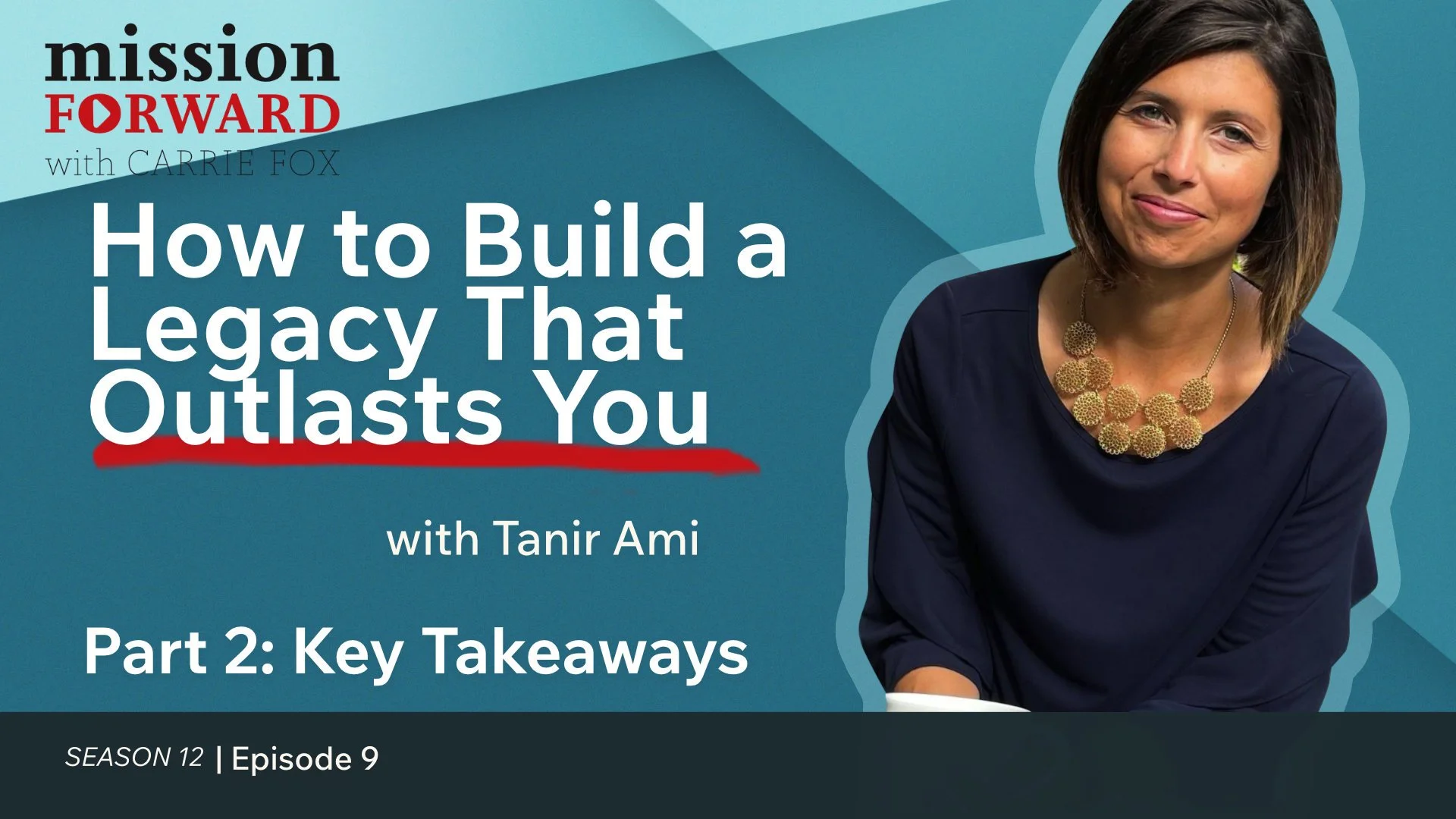
How to Build a Legacy that Outlasts You Part 2: Key Takeaways
About This Episode
In 2020, the emergency announced itself. The need was visible, the urgency undeniable, and that clarity gave leaders permission to act — to move a million dollars across town before lunch and hand-walk the check to a barely-open UPS store.
Five years later, Carrie Fox reflects on her conversation with Tanir Ami of the CARESTAR Foundation and lands on a tricky puzzle: the urgency hasn't gone away, but it has gone quiet. The systems are still shifting, but they're shifting in ways that are less visible, and that invisibility is what makes them so hard to act against. This is where a North Star stops being a poster on the wall and becomes an operational imperative.
This week, takeaways from an important and ongoing conversation: clarity of purpose makes action possible, strategic planning is a lifeline rather than a luxury, and the most meaningful impact is the momentum you’ve created, and then leave behind. And for CARESTAR, that momentum has a name — eliminating racial disparities in emergency medical services. What they measure as achievement isn't just in the form of grants or the dollars deployed. It's that an organization sitting just outside the center created the space for a statewide conversation no one else could convene, and then committed to keeping that conversation alive long after its own work is done.
If you haven’t listened to the main conversation with Tanir, it’s a good one. You can find it right here.
-
Carrie Fox:
Hi, I'm Carrie Fox and welcome back to Mission Forward. This week I am reflecting on my recent conversation with Tanir Ami. Tanir is the CEO of the CARESTAR Foundation, a California-based foundation with a mission that is clear and courageous: to eliminate racial disparities in emergency medical services care across the state of California. If you haven't listened to that conversation yet, I invite you to go back and listen. What Tanir shares goes beyond strategy or even mission. It is a wonderful lesson in what it looks like to lead with both clarity and courage — two words I talk about a lot here at Mission Forward — especially in a moment that can tempt us to want to hide under a rock until the storm passes. But we can't. And here are my top three takeaways on why we can't.
First, clarity of purpose is what makes action possible. Tanir described leading through COVID with a kind of decisiveness that she said feels different from today. And what she named was something I keep turning over. In 2020, the urgency was undeniable. The need was so visible, so immediate, that it gave everyone permission to act and to act boldly. In Tanir's case, she literally walked a one-million-dollar check to a UPS store that was barely open, just to get resources moving faster. Today that uncertainty is just as real, but it's a whole lot quieter. She described it as systems shifting in ways that are less visible, and that invisibility makes it harder to move with the same speed and boldness. The lesson I took from that is this: when the urgency is unclear, the clarity of your mission has to do the work that that moment used to do. That's why having a North Star matters so much right now — because it gives you permission to act when the fog is thickest.
Second, strategic planning is not a luxury. It is a lifeline through the hard moments. I know that for many of you, thinking about long-term planning can feel nearly impossible. And so why even do it? Tanir and I have had that exact conversation. Are we planning for three years or five years? Can we even plan at all? What can we commit to? What we found in working together is that the most important output of a strategic plan isn't the plan itself. It's the focus. It's that moment when you ask yourself: if we could change just one thing, what would it be? And then you name it clearly and publicly. For the CARESTAR Foundation, the answer was eliminating racial disparities in emergency medical services. And once they named it, everything else got easier. The priorities became clearer. And that's what I love about a North Star — that's what a North Star does for an organization in transition.
And finally, the most meaningful impact is the momentum you leave behind. When I asked Tanir what she hopes to be able to say ten years from now about this work, she didn't talk about grants or outputs or dollars deployed. She talked about embedding a commitment to racial equity so deep in the EMS system that it outlives and outlasts all of us. She said — and I want you to sit with this — that sometimes it takes an organization that sits just outside the center to create the space for a statewide conversation that no one else can convene. I mean, that's a theory of change. The resources matter, yes. But what Tanir is really building is permission for an entire field to see itself differently — to talk about something it hadn't talked about before, and to keep talking about it long after the CARESTAR Foundation's specific work is done. And that's legacy. It's a beautiful model for any of you thinking about what lasting impact actually means.
That's my reflection for this week, my friends. If you have not heard the full episode with Tanir, please go back and listen. The work she is leading at the CARESTAR Foundation is exactly the kind of focused, courageous, and community-rooted work that this sector needs more of right now. I have loved working with Tanir and her team, and this conversation only deepened my admiration for her. So, until next time, keep your mission moving forward, and thanks for tuning in.
