About This Episode
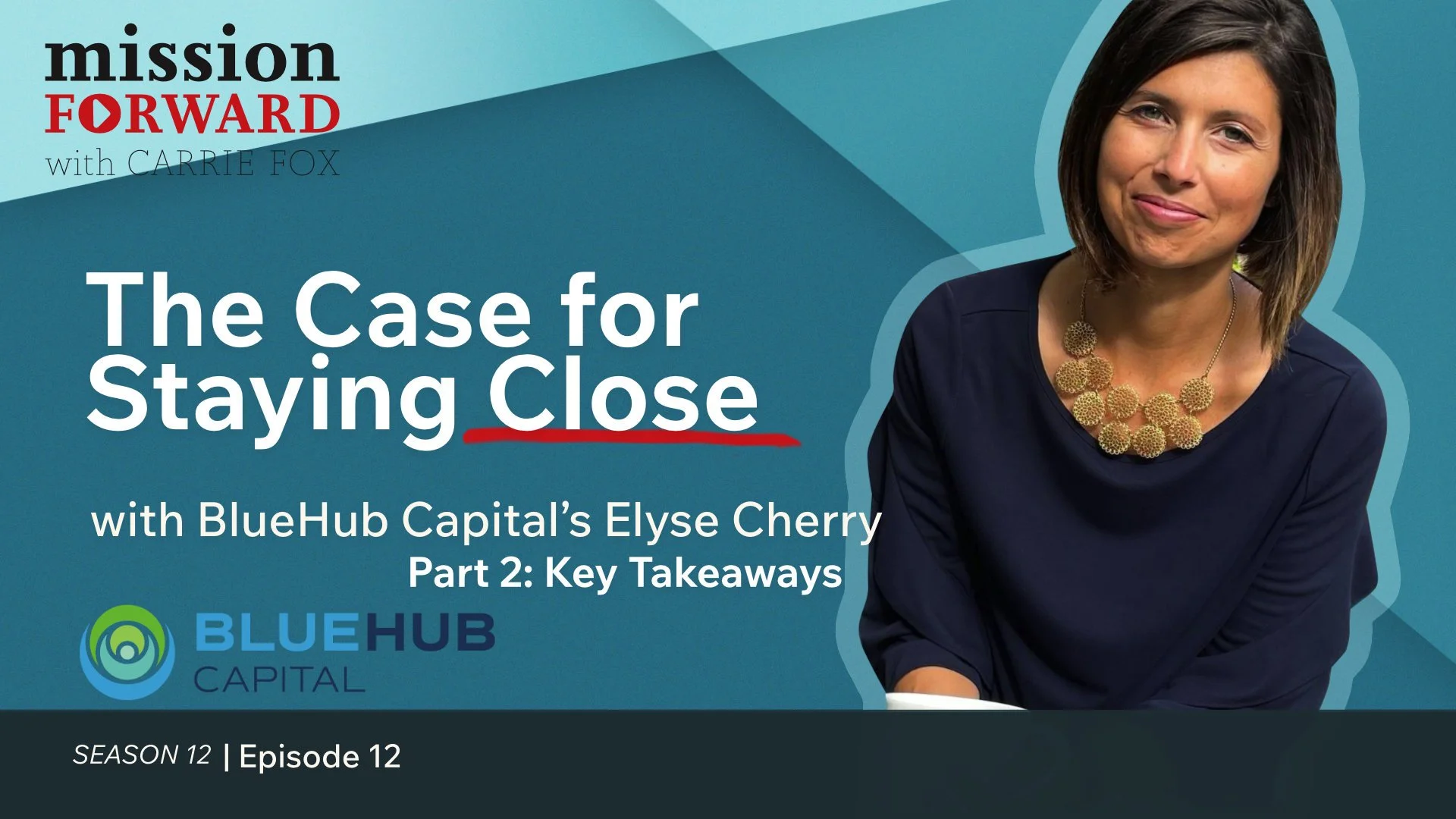
Forty years into leading one of the country's pioneering community development financial institutions, Elyse Cherry has changed nearly everything about how BlueHub Capital does its work — and nearly nothing about why. In this week's reflection, Carrie Fox sits with what that distinction makes possible, and why the leaders who last tend to be fixed on a question rather than attached to a product.
It's a short conversation about proximity, persistence, and a particular kind of courage — the quiet kind that looks less like defiance and more like refusing to stop. If you've ever felt forced to choose between staying true to your mission and adapting to the moment, Cherry has a reason to think you've been asked the wrong question.
-
Carrie Fox: Hi, I'm Carrie Fox, and welcome back to Mission Forward. This week I'm reflecting on my recent conversation with Elyse Cherry. Elyse is the co-founder and CEO of BlueHub Capital, one of the nation's pioneering community development financial institutions, CDFIs, built on the belief that healthy communities are possible everywhere and for everyone. Elyse has been leading through recession, housing crises, and political upheaval for four decades, and she has never once lost the plot of why she does what she does.
Now, if you haven't heard our full conversation, go back and listen to it. It's terrific. What Elyse shares about resilience and proximity and purpose is the kind of wisdom that only comes from 40 years of doing the work. And here are my top three takeaways.
First, your why is what makes the how possible. Elyse said something early in our conversation that I have not stopped thinking about. She said that BlueHub didn't center its mission on a product. Not loans or grants or any one tool. They centered their mission on community. And because that why never changed, the how could. So over 40 years, they have run a community development venture capital fund, a utility cost reduction company, a foreclosure prevention initiative, a citizenship access program. Completely different business lines, but every single one of them is aimed at the same North Star. As Elyse says, what does this community need right now to be healthy? And that kind of clarity is really powerful. For anyone out there who feels like you have to choose between staying faithful to your mission or adapting to the moment, Elyse reminds us that you don't. You just have to know which is which.
Second, proximity is not a strategy. It's a precondition for impact. Elyse described it as community values and downtown expertise, and I think that framing is really smart. She's a trained attorney who spent years in a big law firm. Elyse knows how to build housing and finance schools and structure deals, but what Elyse also knows is that they don't know what a community needs. Only the community does. So staying close is non-negotiable. Their offices have always been inside the communities they serve. They encourage their staff to serve on local boards. They stay connected. And the result of that proximity is something you can't engineer from a distance. It's like this great story that Elyse shared — financing a Cape Verdean grocery store right next to a community health center, because they understood that food and health in that neighborhood were the same issue. That connection happens when you're on the ground, you're there, you're embedded in the community, working in proximity. So for all of you leading from a distance right now, trying to figure out how to get closer, I'd invite you to ask yourself: what might you be missing? And what does it take to close that proximity gap?
Finally, courage can be quiet, but it cannot be silent. Elyse said this to me a few weeks ago, before we sat down to record, and it really stuck with me. What Elyse means, I think, is that courage doesn't have to be loud or dramatic or visibly defiant. It can be steady. It can be methodical. It can look just like putting one foot in front of the other, even if you don't know what's in front of you. But what it cannot be is still. Because if you stop, Elyse said, the people who don't share your values win by default. It's almost mathematical. And so the obligation for Elyse and BlueHub Capital and all of us is to keep moving forward. To ask, in the context of where we are right now, how do we keep going? How do we make sure our organizations are strong enough to get through the hard stretch and come out the other side still doing the work? That's what quiet courage looks like in practice.
Well, that's my reflection for this week. Thanks again to Elyse Cherry for joining us on the show. Thanks to Matt Price for the great research brief he shared last week. And thank you for tuning in and listening and supporting this show. Hope you have a wonderful rest of your day, wherever you are. Keep moving your mission forward, and I'll see you next time on the Mission Forward podcast.
