About This Episode
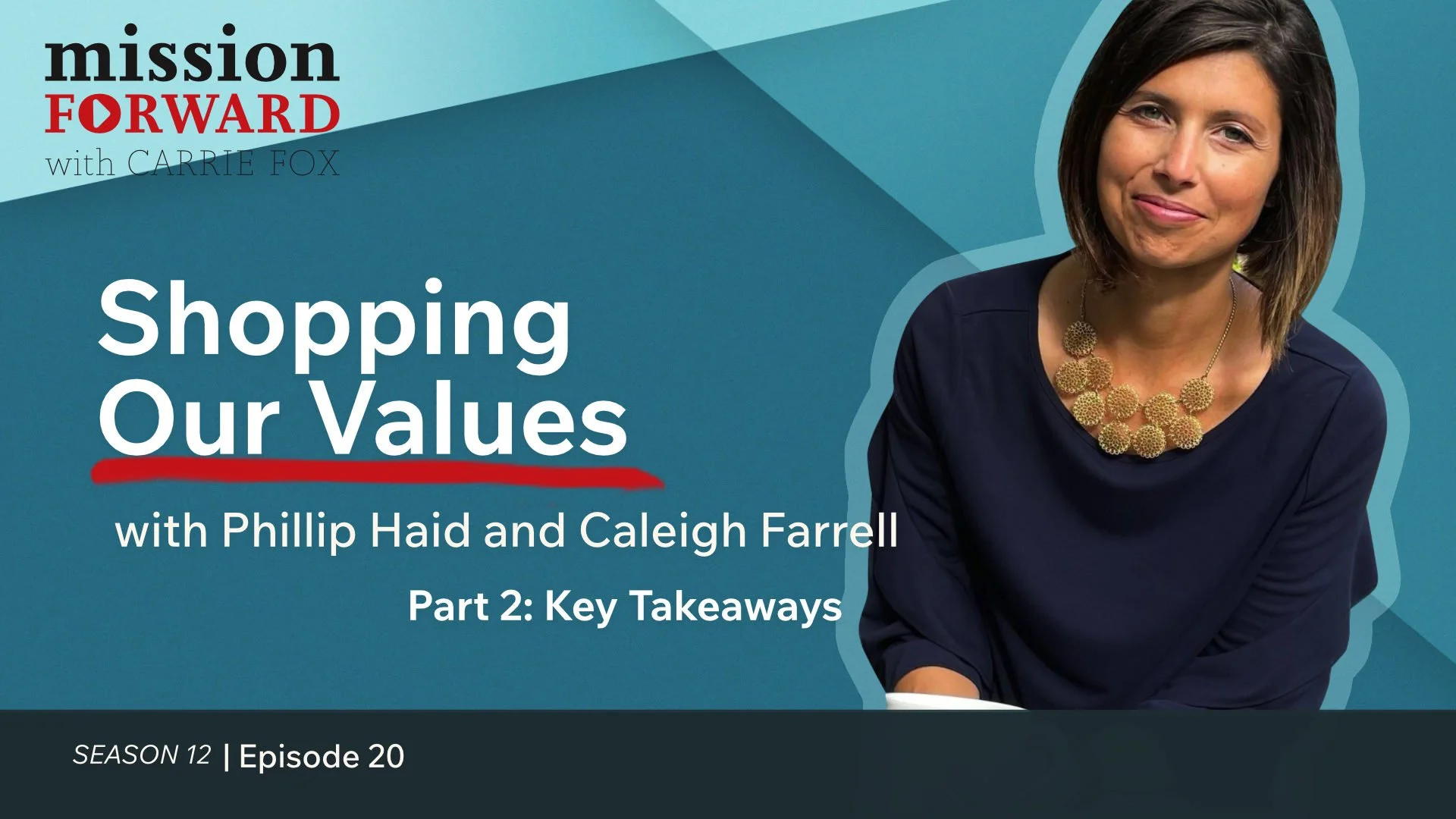
Forty percent of consumers say they shop their values, and that number went up this year, during an affordability crisis and loud pushback against so-called woke business. In this week's reflection, Carrie Fox returns to her conversation with Phil Haid and Caleigh Farrell of Public about the 2026 Conscious Consumer Report and the balloons it popped along the way.
The lessons keep coming back to language, from why a few more words can make a claim land to what a name that leads with what you're not might be costing you. Carrie closes with Phil's question for anyone who went quiet this year to stay safe: what good work are you doing that the people who most need to hear about it don't know about?
Link Reference
-
Carrie Fox:
Hi, I'm Carrie Fox, and welcome back to Mission Forward. This week I am reflecting on my conversation with my friends at Public. Earlier this year, I sat down with Phil Haid, Public's co-founder and CEO, and Caleigh Farrell, their VP of research, who led the team behind their 2026 Conscious Consumer Report. This season, as you may have picked up on, we are grounding ourselves in data, because when so much feels uncertain, it helps to start with what we actually know. And I thought when I came across this research, it was really interesting, right? It helped pop some balloons on issues that I thought I understood, but really helped me understand them more deeply. And that's really around consumer choices. Why we buy, what we buy, what influences those decisions, and what's behind those decisions. The research is packed with insights, and it's one of the more practical episodes that we've done this year. And here are my top three takeaways.
First, and I don't say this lightly, don't believe the headlines. Doing good isn't a niche or a partisan issue. It's mainstream. Phil told me that they started this research to, as I said earlier, pop that balloon. The popular story says people will pay more for brands that do the right thing, but it didn't match what they were seeing in their work. So they decided to measure it. 40% of people say they shop their values. That's actually up a bit from 38% last year, during an affordability crisis and loud pushback against so-called woke business. They expected that number to fall, but it actually rose. Even more striking, 68% of consumers shop their values at least some of the time.
That research also overturned some myths. First, that income doesn't predict who shops their values. In fact, what they found is the most committed group is also the most price sensitive. And politics doesn't predict it either. Among those most committed shoppers in the US, the split between Democrats and Republicans is nearly even. As Phil put it, this isn't about political persuasion. It's about people wanting better for their health, their families, and their communities.
Second, me now beats we later, even if it takes a few more words. This finding I thought was really interesting, because claims about a benefit to me today can outperform claims about a collective benefit someday by three or four times over. So Public worked with some of their clients and rewrote the claims and then tested them again, right? "Certified organic" becomes "grown organically to be safer for you and your family." Or "made with less water" becomes "made using recycled water to keep our rivers and lakes cleaner." The commitment behind each claim is the same, but the new language, even with a few more words in it, shows people why it matters. So in nearly 70% of the cases, the new version performs a whole lot better. People want to understand what's behind a phrase like "certified organic."
Caleigh added something that I really appreciated too, right? So much of our language leans in on the word less. Less plastic, fewer emissions. But nobody shopping from a scarcity mindset wants less. And that's true in our sector too. We call ourselves nonprofits, which leads with what we're not. So, uh, as Phil and Caleigh prompted me, and I prompt you back, where are you describing yourselves in a way that shows what you lack instead of what people gain by working with you? And how might you say it in a more plain or human or, as they say, kitchen-table language?
And finally, silence doesn't rebuild trust. Doing the work and talking about it does. Public's research found what they call a confidence gap. People believe businesses have enormous power to make a difference, second only to the government. But they have little confidence that businesses will actually follow through. When trust is low, the instinct is to put your head down and say nothing. Phil says that's backwards. If you've done the work, you can back it up with what you say, and you know your audience, this is the moment to speak up across channels, because that is what builds trust. It isn't just doing the work and then communicating. It's doing the work and communicating simultaneously. For anyone who has gone quiet this year to stay safe, here's a question that Phil posed that I'll also pose to you. What good work are you doing that the people who most need to hear about it don't know about?
All right, that's my reflection for this week and a couple questions to leave you with. What stays with me most is how all of the lessons in this episode come back to language. Many of us were taught that shorter is always better, right? Make it punchier, make it tighter. And when the climate gets hard, quiet is safety. Phil and Caleigh's data says otherwise. Sometimes the right words are a few more words, as long as they're simple, specific, and human. And sometimes the bravest thing an organization can do is keep talking about the work it believes in. Finding the words is the work I care most about. And this conversation reminded me that it's not always about finding the perfect words. It's also about helping people see themselves in what you do.
I'm so grateful that Phil and Caleigh were able to share some of their time with us and get behind the scenes in their research. Go back and listen to the full episode and dig into the 2026 Conscious Consumer Report. I'll have a link in the show notes, and until next time, keep your mission moving forward. And thanks for tuning in.
