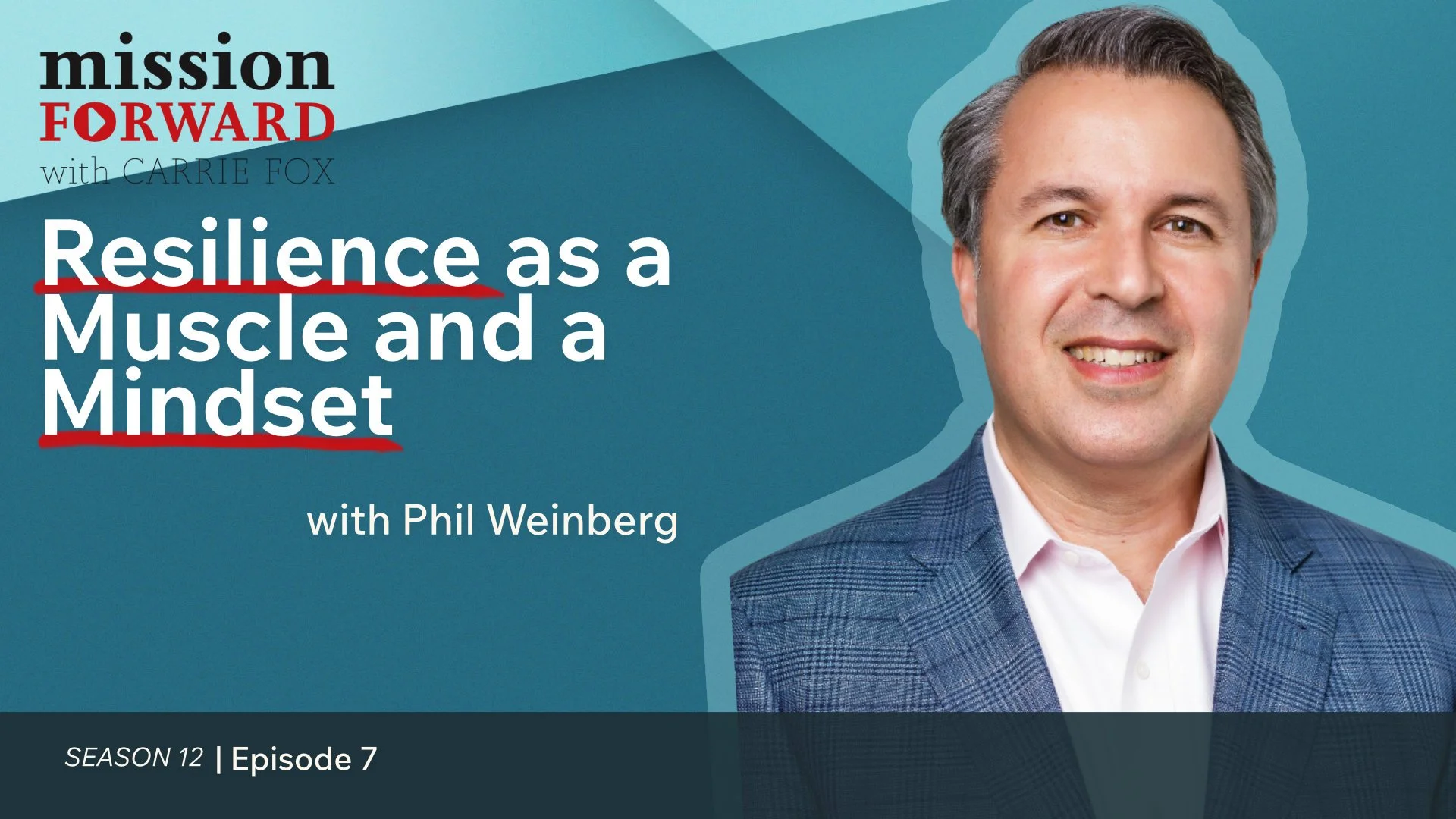
Resilience as a Muscle and a Mindset with Phil Weinberg
About This Episode
Every generation inherits a story about how people move up in the world. Go to college, the story goes. Get the degree. Climb. It's a story that has shaped policy and philanthropy for three generations running, and for tens of millions of Americans, the story does not describe reality. What remains is a gap. Not a talent gap, as this week's guest is careful to distinguish, but an opportunity gap.
Two populations standing on opposite sides of a chasm, motivated people looking for a path, and employers who cannot find workers. This chasm is not bridged by ambition alone. It has to be built.
Phil Weinberg has spent fourteen years at STRIVE building exactly that kind of bridge, and what makes his account worth hearing is the architecture underneath it. This week, Carrie Fox talks with Weinberg about what it takes to grow a nonprofit through three successive crises without losing the thread, why he draws a sharp line between individual resilience and the organizational kind, and how the conventional wisdom American philanthropy has held about nonprofit overhead may have had it backwards the whole time.
It's a conversation about consistency as a form of leadership, about the unglamorous decisions that compound into durable institutions, and about what happens when an organization stops apologizing for the infrastructure that makes its mission possible.
This week also marks the debut of a new recurring segment on Mission Forward: Research Briefs, a short conversation tucked into the end of each episode for the next three months, featuring Mission Partners' Researcher in Residence Matt Price. In each brief, Matt connects the themes of the week's conversation to what the latest data is telling us about the field. This first installment puts Phil Weinberg's reflections in context with new Gallup data on how American workers are feeling about the job market — and what the numbers reveal about resilience, leadership, and the gap between struggling and thriving. Stay tuned at the end of the episode.
Links & Notes
STRIVE's Story (40-year history, founded in East Harlem, 1984)
STRIVE Programs (Career Path, Future Leaders, Fresh Start)
STRIVE Network (directly operated sites in Atlanta, Birmingham, New Orleans, and New York, plus affiliate partners)
Gallup: U.S. Worker Thriving Declines as Job Market Pessimism Grows (March 2026 release)
-
Carrie Fox
Hello and welcome to Mission Forward. I'm Carrie Fox. For more than 25 years, I have worked alongside nonprofit and foundation leaders who do the essential work of holding communities together. And often they, like you, are doing the work in moments of deep uncertainty. But what happens when the moment requires more than we have? Well, that's why this season we are going behind the scenes of our brand new 2026 Insights on Purpose report. It's research that takes the pulse of hundreds of nonprofit and foundation executives all over the country, and asks a simple but profound question. How ready do you feel for what's ahead? Well, what we found in that research was striking. Leaders are under historic pressure, and yet many still feel very confident about the future. And that tension between concern and confidence and how to lead through it? Well, that is the space we are exploring all season long. Today we are talking with one of the nonprofit executives who is leading and innovating through the change, helping to close some of the most important gaps in our American workforce. Phil Weinberg is the president and CEO of STRIVE, one of the nation's leading workforce development and career solutions. Based in New York City and operating nationwide, STRIVE offers tuition-free skills and job readiness training, one-on-one support, and get this, lifetime personal coaching for people who are motivated to see beyond their circumstances and actualize the best of their future. How much do you love that? His impact and the impact of the organization is extraordinary. There have been ninety thousand graduates having completed job training programs and moving into jobs and careers within essential industries and in-demand fields. What I love most about STRIVE's mission is that it sits at the intersection of so many of the forces that are reshaping our workforce right now. The changing labor market, the rise of AI, and how we figure out how to navigate through it, and that growing gap between what our communities need and how ready our workforce is for what's ahead. Phil is living in those intersections, and I am excited to learn from him today. Phil, welcome to the show.
Phil Weinberg
Yeah, real pleasure to be here.
Carrie Fox
So uh Phil, STRIVE has been around now for more than 40 years, and you have been the executive at STRIVE for for many. Is it is it 12? Is it 15? How many now?
Phil Weinberg
Uh believe it or not, it's fourteen and counting.
Carrie Fox
It's 14 years. Okay. All right. So let's talk about this because you were clearly in this seat during COVID. You have gone through moments of deep uncertainty. You have led the organization, helped grow the organization. But what I keep hearing from leaders is that this time is very different than leading through COVID. And I'm curious how that's felt to you, how you compare having led through those two key moments.
Phil Weinberg
Well, you're you're exactly right uh in in that um I have been at STRIVE through the rebound of the Great Recession, uh through all of COVID and now through the turbulence that we're experiencing now for all the reasons you mentioned: shifts in policy, funding, labor market, uh disruptions in technology. I'll start with what feels familiar. What feels familiar is the uncertainty. So in different moments of turbulence, it might have been around public health uncertainty or economic uncertainty. But navigating uncertainty and needing the agility and the dexterity to be able to adapt as an organization, remain true to your values. So not change the focus and mission of the organization, but ensure that how we show up for our communities is meeting the needs of the times. The importance of engaging with partners. So during times of stress, alliances, coalitions, close partners, never more important. Um, and certainly the communities in which STRIVE works and operates and serves, um, primarily low-income communities, uh predominantly communities of color, often bear the brunt of the turbulence that are felt through these different shifts. So all of that feels on some levels familiar. Now, what feels different about this time? I'd say that the uncertainty now is coming from multiple different directions. And so uh economic policy, funding, uh technology. Uh and so it feels more fractured. In previous moments of turbulence, there's been this notion that we are all in this together. We are all navigating through a similar set of uncertainties together. Um and it feels more polarized now. So in previous um moments of uncertainty, organizations might have been experiencing the uncertainty similarly. And now I think organizations like STRIVE and many others are experiencing this very differently. And also the support system. We all remember during uh times of stress, stimulus funds might come in to provide a backstop for the work that we do. Some of us may recall uh supports like the the PPP uh and other supports, the paycheck protection program, so that in moments of stress, the federal government really stood stood up and and and leaned in.
Carrie Fox
Yeah.
Phil Weinberg
And I think at this time we're seeing the stresses and fractures quite quite differently. And I'd say on a final note, what feels familiar is that what feels in many cases like a moment of crisis can also be seen as an opportunity. And so many of us are looking at how we can learn and lead through this moment and become stronger and more resilient as a result.
Carrie Fox
Ha ha, you used the word I was hoping you'd use, uh which is resilience, which is the next question. Because this is such a strong theme, is this need to have resilience, right? Both at the senior levels of the organization. We're talking about leaders who have led through a major crisis with COVID and now continuing to lead through crisis, as if crisis just doesn't stop. It's not just change, it's it's ongoing sustained crisis. And the ability to have the resilience to navigate through that is important at every level of the organization. And I'm curious if you've done anything differently in terms of how you build and foster that with your team.
Phil Weinberg
Absolutely. So I'm I'm gonna distinguish between individual resilience, personal resilience, um which is a mindset. It's how we overcome obstacles, it's how we join together and get through tough times. And in fact, resilience is one of our core values at STRIVE. We draw inspiration from our students who come to us having navigated and overcome significant obstacles and demonstrated resilience. That really becomes part of the fabric of STRIVE, of of our DNA as an organization. Then there's the organizational resilience, which is not just a mindset, but it's really also a muscle. It is the practices that you develop as an organization, oftentimes built over long periods of time. And in many cases, you benefit from having gone through stresses of previous moments of crisis. So I think about the different types of resilience organizations can build in order to support their strength in weathering the storm. Do our staff feel supported and secure? Well, certainly there are uh strategies like compensation policies and paid time off. I can't tell you how um something simple like closing down a nonprofit between Christmas and New Year's, which STRIVE does and I know many organizations do, um allows staff to come back feeling refreshed and and and rejuvenated. Do we have resilient leaders and do they work well together during times of stress? We're actually working as a team now to ensure that we are coming at this with a one STRIVE, one organization mindset so that as we're working through times of stress, we can ensure we're having conversations that lean into conflict and ensure that we are meeting the moment. Can boards play a stabilizing role through times of stress? Do we have financial reserves as organizations? Do we have access to lines of credit and the financial tools we need in order to weather what can be difficult and challenging times? Do we have the right data to make decisions? Whether it's data about the success of our programs or our financial data to make sure that we are making, we have the information we need to make good judgments. Do we have diversified revenues? Do we have strong partners? And so all of these are um components of organizational resilience that I think are built up over time and really become a reservoir that places like STRIVE need to lean on during times of stress.
Carrie Fox
I absolutely love that. I love first and appreciate how you broke down the difference between the individual and the organizational, and that muscle and mindset breakdown that you just gave us is really helpful. Uh you all uh both appear to me, but also I know because I've had a chance to work with you all, that you've got really important systems in place. I mean, you talked about resilience is one of your core values as an organization. And yet, going through this time, we know that it still requires different things of leaders. Have you put anything into place? And it's okay if you haven't, but anything into place over the past year or two that you think has helped to support your team, your organization in that resilience mindset? So any any new benefits, services, offerings, changes to your strategy even that have been important to where you are right now.
Phil Weinberg
I think one of the advantages that we've had is that we've been thinking about how to navigate through disruption and how to navigate through growth. And so working with a growth mindset around what are the capabilities that we're going to need organizationally in order to be the organization we're looking to become in the future. And so we've started building new capabilities at STRIVE. We've we've been able to build up entire new competencies organizationally. This is everything from human resources practices, so bolstering teams that are supporting the members of our team who are doing the work and powering STRIVE, to bolstering our ability to generate revenues. And in particular, we've been doing a lot of work around how we support our work around accessing government and public revenues. So you can imagine a world in which there's now this this tectonic shift in how the federal government could be funding services like the ones that STRIVE that that STRIVE provides. And having that running start about engaging with policymakers, engaging with public stakeholders at multiple levels, federal, state, county, local, um I think has built an ethic organizationally uh and built uh a a sort of a platform um from which from which we then can build resilience. As you know, uh uh because we've done a lot of uh work around uh building up our brand identity, but building a uh a top-tier marketing capability. So these are all the ways in which organizationally we've been building strength, building capacity, building team, building culture. I should note we're doing this as we're expanding geographically, so we're very intentional about the way that we're building a support system and a culture to ensure that we are not just surviving and weathering the storm, but we're really um building strong healthy practice, healthy culture, focusing on those aspects of our of our um value system that are so important, such as ensuring that we're doing our work with quality, durability, engaging with deep partners, and to sustain over the long term.
Carrie Fox
So I I want to turn and talk about actually those services in a minute. And first I want to just name something of of the other thing I appreciate about what you're talking about is that you are are so clear in your um commitment of understanding that STRIVE is a business. STRIVE, yes, is a nonprofit business, but it's a business. And you are thinking about diversifying your revenue streams, you're thinking about different types of partners, clearly uh have have um built so many powerful corporate partners and employer partners. We'll talk about that in a minute. But I appreciate how much of a business mindset you bring to running the organization.
Phil Weinberg
Absolutely. We we we we spend an inordinate amount of time thinking about um the economics of the work we do and the economic model. And that's both the the the revenue base and how to make sure that it's it's not just diversified, um, but it it's consistent and repeatable. Um and also our our um expense base and how to ensure that we are always scrutinizing, leading with our values, ensuring that we are making good choices and we are structuring and building the organization so that it's sustainable over the long term.
Carrie Fox
So let's talk about those services, because the services that you are providing are some of the most mission critical. I think about right now, all of the news stories I've heard in recent weeks about the nursing shortage and the healthcare shortage and how we're going to close these labor market gaps in America. Well, that is one of the very critical areas of focus you all have in terms of healthcare. Um and and would love you just to talk a little more about the services that you provide and how you work with partners, whether it's healthcare or otherwise, to help close some of those gaps.
Phil Weinberg
Absolutely. So we are mindful that there are, across our country, there are talented, motivated individuals who are hungry to build a career. And similarly, we've got segments of our economy that are desperate for talented individuals. So there's a there's a mismatch. And the mismatch isn't just a talent gap, it's an opportunity gap. There's a mismatch in access between those who are looking to build careers and those employers and corporations that are looking for a talented workforce. And so what STRIVE does is we we work hard to close that gap and to bridge that gap. And so we find um sectors of our economy, we look for industries where the conditions for good jobs are present with advancement potential and the barrier to enter at an entry point is not out of reach for someone who doesn't have a post-secondary degree. So you don't have to go to college. Uh, but if you've got the right credentials, the right workplace habits, and you've got the right access, you can really differentiate yourself and distinguish yourself in the workforce. Healthcare happens to be one of those areas where we've seen for years great potential in communities. It is a wonderful entry point into careers that have advancement potential. And interestingly, it happens to be, if you look at recent uh labor reports, labor market reports, one of the real bright spots in the economy. So the demand for healthcare services is is significant and showing no signs of uh signs of dissipating. And for us, that's both on the non-clinical and clinical side. So people think of hospitals, they think of doctors and nurses. There's a whole army of individuals it takes to support a health system, from the environmental and cleaning teams to the logistics teams, to the patient care teams, the medical billing and coding, all kinds of sterilization roles. And so this really becomes fertile ground to create entry points into opportunities that can really change somebody's life. And so what STRIVE has done, starting here in our home base in New York, working with the largest hospital systems, building real pathways based on the demand that the employers have articulated to us. And then as we engage in other cities around the country, partnering closely with those employers and those health systems, great partnerships with the premier hospital systems in places like New Orleans and Birmingham, Alabama, and Atlanta and other communities where we are currently present and where we're growing. So we see healthcare as a very uh promising platform from which to enter a career and then to grow.
Carrie Fox
And Phil, what I want to reinforce here is that it's such a huge human services approach that you are taking. I mean, these these are not skills that could easily be replaced by a robot. At least not right now. I mean this is very much about person-to-person care uh in terms of the kinds of jobs that you're training for. And yet I can't help but wonder, what does it mean for those job training programs that focus primarily on coding or technology, right? Do you feel like you're a bit um uh, I don't know, um, protected by that because of the kinds of jobs you're training for? How do you think about that impact of AI on your work?
Phil Weinberg
Well, I will say it's something we're we're carefully assessing. We pay very close attention and we're in constant communication with our employer partners to understand the implications of AI on the skills that are required, on the positions that they're hiring for, and kind of how they're seeing the outlook uh for for their labor force. And I think you're spot on. We we we find ourselves in a number of industries that are very human centered. So healthcare and patient care are ones in which there continues to be a great demand for individuals that have those skill sets. And I will say one of the areas that that STRIVE really focuses is not just the technical skills, but on those human skills. So we spend significant time with our students learning about how to uh succeed in the workplace, working within teams, uh focusing on customer service, managing conflict, working well within an enterprise. And so what we're finding is in many of those instances, the implications of AI are not yet as disruptive as you find in other sectors. We're finding the same. We do a lot of work with construction and the trades. We do a lot of work with employers in logistics and supply chain. And we're finding that um while the implications of AI may be seeping into their workflow, it's yet to fundamentally shift the way in which they're looking at positions and the way in which they're hiring. And so for us, while we pay attention to white papers and look carefully at at the data and where the field is going, what's most important to us is not to be ahead of the labor market. So we're working closely with our employer hiring managers to understand how they're seeing the shifts and we ensure that where new skills are needed, that we're adjusting our curriculum and making sure our graduates have those.
Carrie Fox
And that feels like a really important point to stress, because I think I know this, but I want you to clarify it. This idea of adjusting your curriculum, that an employer who maybe is listening to this right now and saying, well, we are feeling a massive shortage and we don't know where to go to look for these um jobs and positions, that they're not necessarily coming to STRIVE and doing a plug-and-play curriculum. They are potentially building that curriculum with you. But is that correct?
Phil Weinberg
Absolutely. So so there are commonalities to our curriculum. There are aspects, there are credentials that are recognized by the industry, by industries that become important components of a graduate's toolkit. But we are working very closely with employers to understand not just the skills, but what is the environment within their workplace? And what does it take for someone to succeed? And we are constantly designing and redesigning our programming based on the specific feedback that our employers have. And there's also instances where they're interested in testing their ability to build new pathways into positions that they may have trouble filling uh with traditional hiring methods. And so those are wonderful opportunities for us to pilot. We do those with our hospital partners all the time, our employer partners all the time. And so while there is a consistency to the program, there's a there's a methodology and evidence around the training model that we have in place that has a very significant support system, coaching component to it. It's absolutely the case that we are agile and constantly adapting and shifting to the needs of a labor market and the needs of our employer partners.
Carrie Fox
Yeah, cool. Okay. All right, so we've got time for maybe two more questions. And there's one I want to ask you about looking ahead and where you're going, but first I want to ask you about um something very specifically tied to the research, which is there's some research that we found within this Insights on Purpose report that made it very clear that demand for nonprofit services is rising faster than organizational capacity. And so here you are at STRIVE, operating across many cities across the US, and you are supporting people who are facing some of the greatest economic pressures, right? There's a lot of demand for your service. What concerns you most about that gap and where do you see maybe some promising opportunities to respond?
Phil Weinberg
So this is a hard one. This is this is a real tension. And we're we've worked hard to really flip the script on this. So the classic case is what is often considered the starvation cycle within nonprofits, where funders may devalue what they consider to be overhead or capacity. Therefore, nonprofits de-emphasize the importance and need for those services. And you find yourself as an organization in this vicious cycle that's hard to dig your way out of. And the result of that can be quite harmful for an organization, can lead to staff burnout, uh, can lead to an erosion of program quality, a lack of compliance, uh stewardship of uh of funders and funding resources. So what we've tried to do with STRIVE is really center that as we grow as a strategic imperative for the organization. So these are no longer, you know, expenses that live at overheads, but these are really strategic levers for us uh to propel ourselves forward. So we've set ambitious goals to grow significantly. We're going to be tripling the number of students we serve in the coming years. We've launched four new sites in the last six years. We launched a site uh uh last year at a time when many nonprofits were were retrenching. And we had to think carefully about how we as an organization can meet this moment. And so I think to do so it's being able to make a compelling case for the value of having that um that strong program quality support system, that strong performance management capability, those strong financial reporting systems and tools. We find ourselves now operating facilities in in communities around the country, having the operational capabilities in order to deliver programs with quality and and consistency. And so we've been fortunate to make a case and have funding partners respond that have allowed us to build the capabilities and the capacity to support our growing services. And now, I wish I could say we always have all the capacity we need in order to serve, to meet all of the demands. Um, and what happens is we make choices as an organization and we try to do so thoughtfully and strategically. So where do we have gaps and where do we need to be thoughtful about how to build up capacity?
Carrie Fox
What I always hear when I hear you speak, which um you do in fact make a very compelling case for the value of your organization, um is is that there is so much to, in fact, the organizational approach that is the value, right? So rather than trying to hide that under the rug, that that is the core part of your value proposition, is the um organizational strategy that you bring to the work, um and not trying to to hide that in the in the cell in some way.
Phil Weinberg
Absolutely. Trying to create an organizational culture of excellence means, you know, it's not just having strong programming, but it's having the infrastructure, the support system. These are the non-glamorous aspects of operating a nonprofit. But for folks that are are are are in that arena, you understand that if the compliance infrastructure isn't there, if the reporting infrastructure isn't there, if the systems aren't in place in order to enable the quality of service, then we're building something very fragile. And so I, it it is an imperative to be able to make the case. Now, look, the case isn't always a winning case. Um but there are funders at the local level, the national level who understand, who trust, who partner and who enable the building of the infrastructure and the capacity in order to deliver quality services for us propelling people into economic opportunity. Um, and to be able to do that at increasing levels of scale.
Carrie Fox
So uh Phil, you and the STRIVE team have many, many elements that a lot of nonprofit leaders who are listening are working to put in place, right? You've got a strong and resilient organization and a team. You've got diversity in terms of the types of revenue that you are building. You've got diversity in types of services that you're providing. You've got excellent collaborations and partnerships. You've got all of these things that together really do make you a kind of future-proof organization. My last question for you is, as you look ahead, you are in this incredible moment of growth. So what gives you the most hope about where you are? And what might you want to make sure people hear and take away from this conversation today?
Phil Weinberg
Well, I want to acknowledge, because I think you started this conversation with recognizing this duality, this tension that exists between concern and optimism. And the concern is there. So these are heavy times. Our our communities are under pressure, our staff members are under pressure, organizations like STRIVE are under pressure. So so so there is a level of stress that is being felt felt across the the nonprofit community. Different organizations are feeling it differently. I will say, despite that, to your point, I am filled with tremendous hope. First of all, there's a, it's very heartening, for as someone who's been uh in this arena around economic opportunity and upward mobility uh for for for for a little while now. Um, this increasing recognition that this work matters, and it matters for our country to be successful, and a recognition that not everybody is going to pursue a four-year degree, and a recognition that it is important for us as a society to value individuals having a second chance, um a recognition that this work, in fact, even in a polarized society, is nonpartisan. It's bipartisan. Whether you come at this because you're fighting for social justice or you come at this because you're fighting for economic prosperity, this is important to the future of our country. And so we feel very heartened at STRIVE. The work we've been doing for 40 plus years, has arrived at this moment at a time when we believe we are making a significant impact and are poised to make an even more significant impact going forward. The advice that I would offer is having a clear and compelling case for why the work matters and how we show up as an organization is distinct and differentiated within the field. Being consistent. Even in volatile times, there's a lot of shifting winds and uncertainties and unpredictabilities, but I think reacting to every shift can be destabilizing for a team, for an organization. And so we try to keep our eye on the prize. We're certainly agile and adapt. We try to lead with empathy. But we also want to ensure that we are focused on the long term and staying true to our values and leaning into our values as we move forward. And I guess that brings me to my maybe final piece of advice, which is even in the darkest of times, there is opportunity for innovation and advancement, to learn as an organization um and even with some pain, to progress as an organization. It happened during previous economic downturns. It's happened during technological disruptions. It certainly happened during COVID. We weathered the storm, we learned a lot as a community. And so I think all of us now facing this moment are poised to move forward with greater resilience, greater durability, uh and hopefully continued optimism for what's possible in this country, particularly when we do it together.
Carrie Fox
Oh, well said. Well, I can speak, having seen you firsthand, that you live those truths, that you as a leader and your organization are remarkable. I admire your work so much. And it it really is, for those listening, STRIVE is one of those genius ideas that becomes more genius as we go into this period of time. And so if you're not familiar with them, go check them out and learn about their work and engage with Phil and the team, because they're doing something that's just remarkably special and critically important for our future. So uh Phil, thanks for being with us today, for sharing your great wisdom, and we look forward to continuing to follow your growth.
Phil Weinberg
Thank you so much. It's been a pleasure.
Carrie Fox
This week we are rolling out a new segment here on the Mission Forward podcast called Research Briefs. You will hear these segments tucked into the end of each show for the next three months. And you'll hear a new voice in these segments too, because these five-minute or less segments feature Mission Partners' Researcher in Residence Matt Price, founder of MPATH Insights, who helps us connect the dots between what we're learning on this show and what the latest data reveals. This month, we're kicking off this new series by connecting some dots to our conversation with Phil Weinberg of STRIVE. Matt, thanks for being on the show.
Matt Price
Yeah, thank you, Carrie, so much for having me. Really happy to be here.
Carrie Fox
So Matt, you got a preview of this show before it was even live. And so I'm curious what you're taking away from the episode uh with Phil.
Matt Price
Yeah, sure. Well, it was fascinating. You know, it said so many interesting things really about um the job market. I think that's what stuck with me. And, you know, that was what sort of spurred me to dig a little deeper because I really wanted to, you know, quantify, you know, what are people feeling, job seekers especially right now. Um, and it's interesting because I knew it was tricky, but I didn't know sort of how precipitously the the change in sentiment had happened over the last few years. So if you sort of back up to uh quarter one of twenty twenty two, so almost like the the beginning of the post-COVID or uh immediate post-COVID era, um Gallup has been tracking several metrics around jobs since then. And um among American workers, they have something that they call the life evaluation index. And for the first time recently, and this this was released in March 2026, um they have a higher percentage of workers saying that they are struggling rather than thriving.
Carrie Fox
That's tough to hear. That's tough to hear.
Matt Price
Yeah. Yeah.
Carrie Fox
That framing resonates with us a lot because that distinction between struggling and thriving is something that we've worked on with many of our clients, including STRIVE, in fact, over the years. So tell us more.
Matt Price
Yeah, sure. Well, so it the about half, forty-nine percent said they're struggling, forty-six percent were grouped in the in their thriving group. And again, this this happened rather quickly. You know, if you go back to twenty twenty two, um, people, there was sort of like a, it was uh mid-fifties saying that they were thriving, low 40s saying that they're struggling. Um so that switch happened really quickly. And in terms of, you know, as you sort of dig to more other related data points and dig a little deeper, um, one of that those things has to do with how difficult it is to find a job now, right? The percent who said that now is a good time to find a quality job in twenty twenty two was seventy percent. In twenty twenty three, according to Gallup, that drops to fifty-seven percent, thirteen points just over a year. We are now at twenty-eight percent. So it was a very steep drop. Um and you know, one thing, Carrie, that I thought was especially interesting was um the educational trends are changing as well.
Carrie Fox
You know, I was just speaking with someone who said it's now expected that any job that gets posted will get at least 300 qualified applications. Right.
Matt Price
Wow.
Carrie Fox
So that 28%, good time to find a job. I understand why. There's a ton of competition right now.
Matt Price
Right. And what's interesting is, you know, those who um have a college education versus those who don't um have a college degree, and you know, obviously you and Phil talked about that dynamic so much. Um, for a long time, those numbers were kind of tracking together. It, you know, whether you were college educated, whether you didn't have a college degree. Um, it's it's all trending down in terms of, you know, is it a good time to find a job? But those two gr parts of the graph were kind of staying the same. Um, in twenty twenty five the percent of folks who had a college degree um started changing even more rapidly to the point that now just nineteen percent of those with a college education say it's a good time to find a job. Thirty-five percent of those without a college education. So obviously, as AI impacts start to be felt, um, and you know, uh the flood of qualified applicants to some of these jobs that um you know, presumably some folks went to get secondary education with the hope that that was going to give them a leg up, um it's just a very different environment now that they're all dealing with.
Carrie Fox
Mm-hmm. So the data is is absolutely reinforcing the way that people are feeling. Uh, so connect the dots back to some of the research that we did. We've got about a minute left here for the wrap-up.
Matt Price
Yeah, so um I know you talked a lot about resilience and of course we did that a lot of that in uh when you and I worked together on Insights on Purpose. Um eighty-six percent of nonprofits um agree that their organization is resilient enough to thrive despite the hardships or challenges it faces. And ninety-two percent of foundations say the same. So it's really um encouraging that even in this, you know, all the challenges being faced, um, that they're able to do that. Strong leadership is really what drives that. About 79% of those in the data said that that's extremely important to developing resilience. And, you know, one thing that I thought was especially interesting, and maybe we can end on this, is um when folks were asked in a different research set, this was um uh an organization, BDO, puts out a a nonprofit standard benchmarking report. 19% said that they had paused their initiatives, about one in five. And I think that's, I think that's low, meaning most people who are trying to make changes are not giving up. They are saying, you know, we still leave in our initiatives. Um, we are going to take other steps to address, but we're going to find a way to survive these challenges while at the same time holding true to our mission and holding true to the things that are most important to us.
Carrie Fox
Um Matt, you do what you always do so well. It's just help us make sense and connect those dots. And what I'm taking away from this, and I do want to go back and listen to it again with those data points, is people are struggling. They're not giving up, but there's only so much that people can do until they do give up. And so listening to these signals, particularly if you're a nonprofit leader or an employer, making sure that you're preparing for your staff and your team through this time feels especially.
Matt Price
Absolutely.
Carrie Fox
All right, Matt, thanks so much for our first research brief. We'll be back again soon for our next one.
Matt Price
Thanks for having me.
